Helping design and engineering professionals discover, evaluate and specify technologies and processes that shorten the design cycle and enable success.



Digital Engineering April 2026
In the latest issue of Digital Engineering, we take a look at the latest innovations in design for additive manufacturing, including the use of natural language inputs, social media cosplayers, and AI integration. The issue also includes a feature…

January Special Focus Issue: Design for Additive
In this Special Focus Issue of Digital Engineering, learn about the latest advancements in design for additive manufacturing, including new software tools, additive in automotive, custom medical devices, and more.
Swedish scientists from the Chalmers University of Technology have developed a method of printing cellulose objects. The research team was also able to mix its cellulose material with a different material in order to produce organically-based 3D printed circuitry.
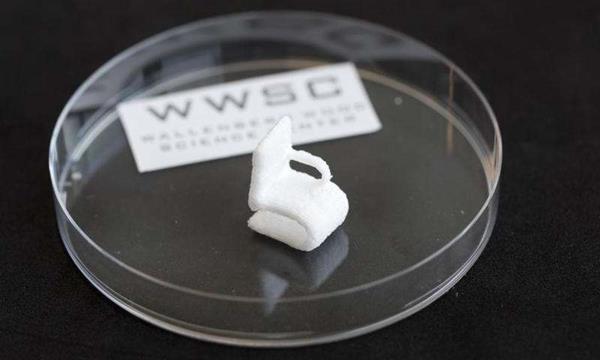 A tiny chair printed from a cellulose gel as proof of concept for Chalmer's University. Courtesy of Chalmers.
“Combining the use of cellulose to the fast technological development of 3D printing offers great environmental advantages,” said Paul Gatenholm, professor of biopolymer technology at Chalmers and the leader of the research group. “Cellulose is an unlimited renewable commodity that is completely biodegradable, and manufacturing using raw material from wood, in essence, means to bind carbon dioxide that would otherwise end up in the atmosphere.”
If you’ve ever roasted a marshmallow over a campfire, you’ve probably noticed that cellulose doesn’t melt when heated, it burns. This characteristic of cellulose makes it more difficult to work with than other materials, many of which can be readily melted down and formed into filament or resin.
The Chalmers research team overcame the problem by mixing cellulose nanofibrils in a hydrogel consisting of 95-99% water. The resulting gel could be fed into the team’s bioprinter and used to produced three-dimensional objects.
A wet glob of cellulose gel isn’t much good to anyone, so the team had to figure out the best way of quickly drying the printed objects to ensure they maintained a recognizable shape. The solution was to freeze dry the objects and to remove excess water while the objects were in a solid form.
Additional experimentation led the team to mix their cellulose gel with carbon nanotubes. This produced an ink capable of printing in three dimensions. Upon drying, the shapes formed by the mix are conductive forming 3D printed circuitry.
“Potential applications range from sensors integrated with packaging, to textiles that convert body heat to electricity, and wound dressings that can communicate with healthcare workers,” said Gatenholm. “Our research group now moves on with the next challenge, to use all wood biopolymers, besides cellulose.”
If you still aren’t sure where cellulose comes from, below you’ll find a quick review of your middle school biology class.
Source: Chalmers


John Newman is a Digital Engineering contributor who focuses on 3D printing. Contact him via [email protected] and read his posts on Rapid Ready Technology.
Follow DE
Join over 90,000 engineering professionals who get fresh engineering news as soon as it is published.






About Us · Contact Us · Editorial Team · Advertising · Privacy Policy · Subscriber Services · © 2026 Digital Engineering 24/7 · Peerless Media