Helping design and engineering professionals discover, evaluate and specify technologies and processes that shorten the design cycle and enable success.


Sponsored
 Dear Desktop Engineering Reader:
The late Chester Gould obviously had faith in engineers and technology. He equipped his comic strip hero Dick Tracy with a two-way wrist radio in 1946, and never stopped coming up with far out gizmos that have become a reality in today’s society — and a possibility in the future. You can’t help wondering how Gould would have drawn Tracy using his Apple Watch to send Tess Trueheart his heartbeat.
Gould wasn’t an engineer. He might not have recognized that inside the Apple Watch beats an engineering marvel. Today’s Check it Out link takes to you to a quick video on simulating the engineering challenges in smart watch development. It’s great fun. Gould would have loved it.
“Wearable Technology – Smart Watch Simulation Driven Product Development” may focus on the design and multiphysics challenges of wearable electronics, but it demonstrates how integrated simulation can help you verify that your design will meet its performance and reliability requirements and get to market on time. Your day job doesn’t have to be developing smart watches. What you’ll see here is easily extrapolated across industries.
The storyline is that simulation plays a critical role in making smart watches possible. Think of it: Crammed into that device are circuit boards, an OLED (organic light-emitting diode) display, wireless communications gear, batteries and whatnot. It has to survive bumps and drops as well as deliver data, text and voice communications reliably. It needs to be affordable to make and simple to use.
The optimization challenges include antenna design, thermal management, structural analysis and impact testing. The video shows you how the ANSYS Workbench platform for simulation workflow can integrate a bunch of ANSYS software to develop a smart watch that has the electrical and mechanical robustness you need for a successful product. Among these applications are ANSYS SpaceClaim for preparing geometry for simulation, ANSYS HFSS for electromagnetic signature analysis and radar cross section determination, ANSYS Mechanical for strength and thermal analysis and ANSYS Explicit Dynamics for assessing impact and drop testing.
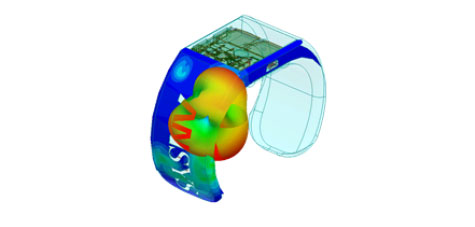 Multiple simulation technologies are required to understand and then improve the performance of devices like a smart watch. Depicted here is a high-frequency analysis used to assess the performance of a smart watch antenna. Image courtesy of ANSYS Inc.
Watching this video will be a highlight of your day, even if it’s just over six minutes long. It’s crisp, colorful and informative. Anybody with intellectual curiosity will gain an understanding of exactly how awesome an engineering feat a smart watch is. Engineers who have not yet taken apart their smart watch will especially enjoy its many animations. All simulation users will be duly impressed. Hit today’s Check it Out link to start watching.
Thanks, Pal. – Lockwood
Anthony J. Lockwood
Editor at Large, Desktop Engineering
Watch "Wearable Technology – Smart Watch Simulation Driven Product Development" here.


DE's editors contribute news and new product announcements to Digital Engineering. Press releases may be sent to them via [email protected].
Follow DE
Join over 90,000 engineering professionals who get fresh engineering news as soon as it is published.






About Us · Contact Us · Editorial Team · Advertising · Privacy Policy · Subscriber Services · © 2026 Digital Engineering 24/7 · Peerless Media