Helping design and engineering professionals discover, evaluate and specify technologies and processes that shorten the design cycle and enable success.



Digital Engineering April 2026
In the latest issue of Digital Engineering, we take a look at the latest innovations in design for additive manufacturing, including the use of natural language inputs, social media cosplayers, and AI integration. The issue also includes a feature…

January Special Focus Issue: Design for Additive
In this Special Focus Issue of Digital Engineering, learn about the latest advancements in design for additive manufacturing, including new software tools, additive in automotive, custom medical devices, and more.
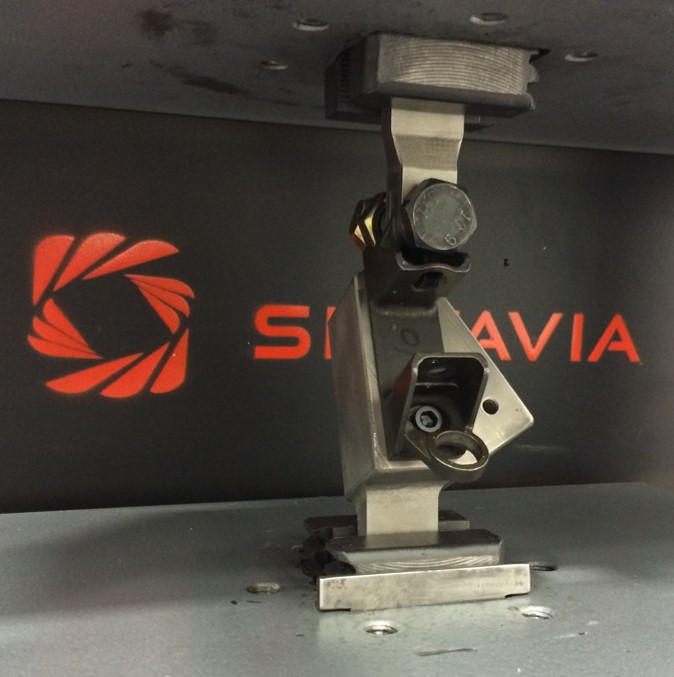 Mechanical load-testing a 3D-printed metal part, produced and tested at Sintavia. (Image courtesy Sintavia)
In 2012 GE Aviation acquired Morris Technologies for in-house work, essentially shutting off that source of high-end metal AM parts procurement for everyone else. Yet in a classic case of “when one door closes, another one opens,” the timing was perfect for Sintavia founder and CEO Brian Neff to start offering similar services all thoroughly certified for aerospace, defense and other industrial customers. (The name Sintavia comes from “sintering” and “aviation.”) For customers who demand quality throughout the supply chain, Sintavia, based in Davie, FL is well on its way.
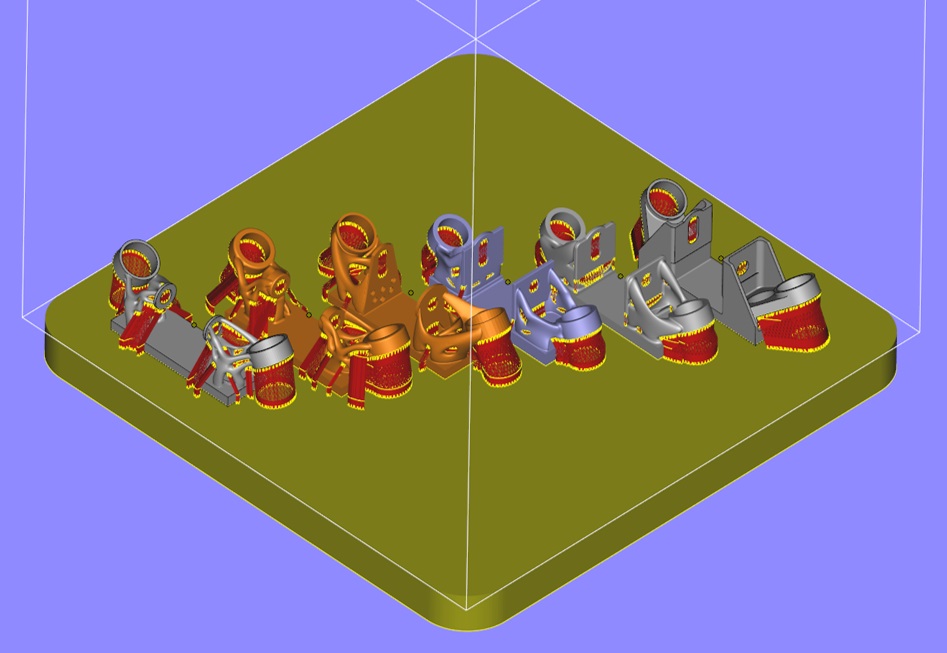 Metal parts laid out on build-plate, with support structures, for 3D printing. (Image courtesy Sintavia)
In fact, notes Neff, Sintavia’s initial investments were not in AM machinery but in setting up powder and metallurgy laboratories. “The first machines we acquired were our scanning electron microscopes and inductively coupled plasma-optical emission spectrometry (ICP-OES) systems (for such tasks as verifying raw powder conformance and inspecting final-part microstructure)," he says. "That’s how we built up our competency, understanding the mechanical properties and metallography, then moving into the machines.”
He adds, “It’s helped us a lot, as we have five different OEMs (i.e., equipment from AM vendors Arcam, Concept Laser, EOS, SLM Solutions and TRUMPF) and they’re all a little bit different in how they print. Having on-site capabilities really helped us qualify rapidly and qualify well.”
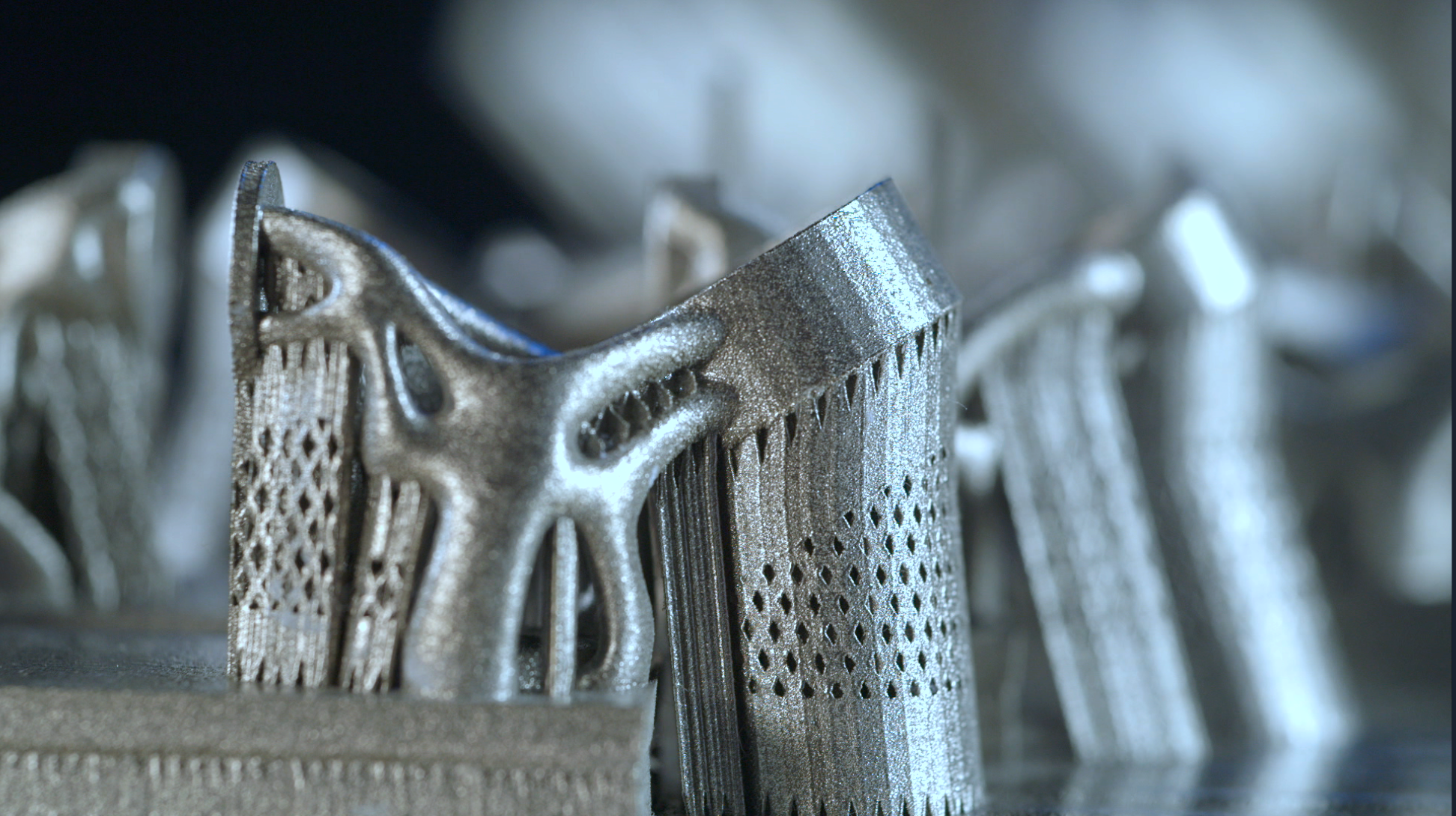
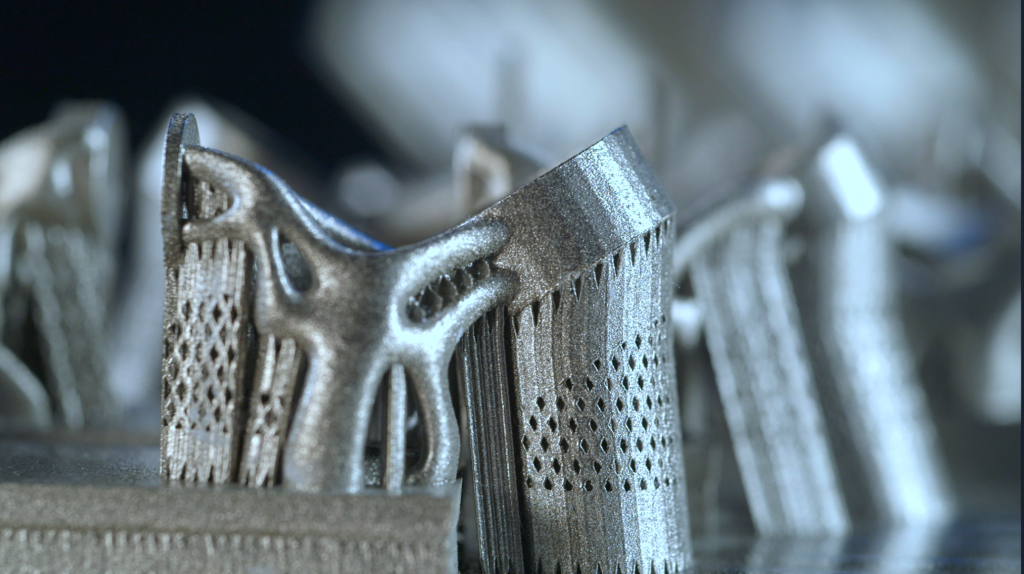 Sintavia sample 3D-Printed metal parts on build plate. (Image courtesy Sintavia)
Material-wise, Sintavia works primarily with titanium, nickel and aluminum, the traditional cast-metal materials, for customers in aerospace, engine design and space applications, respectively. He feels that list will expand over time. The company has previously worked with maraging steel for tooling, and has capabilities in-house for testing and mixing other powdered materials.
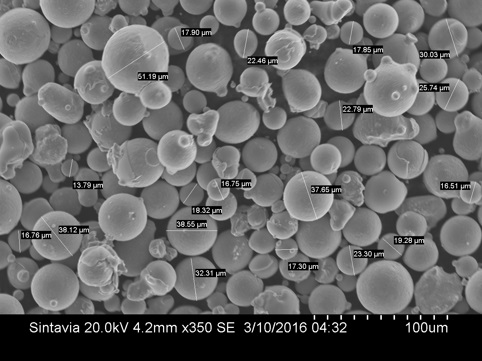 Scanning electron microscope image of raw powdered metal for 3D printing, inspected for consistency of granule dimensions. (Image courtesy Sintavia)
“If you don’t have good certification for a part,” Neff points out, “it’s just an expensive paperweight. We really want to make sure you have good data – not just the way (a part) looks but also what it contains. The FAA is strict about what kind of data you need and that’s our pedigree; people in other industries like power and gas are amazed by the quality.”
Below are just some of the analyses, processes and tests for which Sintavia has equipment and expertise all under one roof:
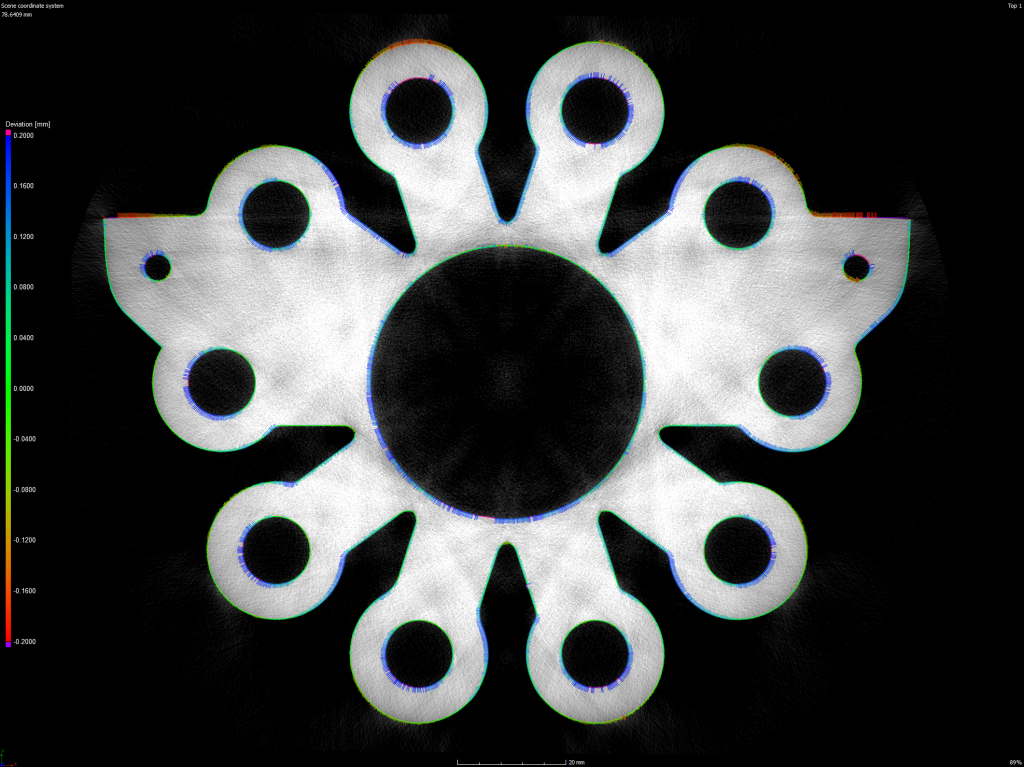 CT scan performed by Sintavia on one of its metal additively manufactured parts — a fuel splitter — showing a fine, uniform level of density and internal passages that traditional contact and line of sight measuring systems cannot evaluate. (Image courtesy Sintavia)
Sintavia believes the Tier One suppliers of tomorrow are not the Tier Ones of today, and that it is already on a path to join the former group: “The only way to do that is to build a good factory system and replicate it near your customers.”
NOTE: Sintavia offers videos with a wealth of fine detail about design optimization, powder testing, post-processing and mechanical testing and analysis. See Optimized Turbine Bracket case study and Sintavia Testing and Analysis of Aerospace Parts Made by Additive Manufacturing.


Pamela Waterman worked as Digital Engineering's contributing editor for two decades. Contact her via DE-Editors@ digitaleng.news.
Follow DE
Join over 90,000 engineering professionals who get fresh engineering news as soon as it is published.






About Us · Contact Us · Editorial Team · Advertising · Privacy Policy · Subscriber Services · © 2026 Digital Engineering 24/7 · Peerless Media