Helping design and engineering professionals discover, evaluate and specify technologies and processes that shorten the design cycle and enable success.


Alert!
Digital Engineering ceased publication on July 1, 2026. This website remains available as an archive of engineering content.
For inquiries or information, please email [email protected].


May 2026 Special Focus: Artificial Intelligence in Design and Simulation
In this Special Focus Issue, learn about the latest developments in the integration of artificial intelligence into engineering workflows.

April 2026 Special Focus Issue: Generative Design
In this Special Focus Issue, Digital Engineering takes a look at how generative design solutions can be used across different types of design problems and with a variety of manufacturing approaches to accelerate design space exploration, and…
Ten-year-old Freyja Christian uses a wheelchair to get around. She also uses her imagination to travel in the realms of fairy tales. In her letter to the Magic Wheelchair, a nonprofit that builds costumes for children in wheelchairs, she specifically requested "a princess castle or a carriage ... flying mermaids, cats, and dragonflies."
When Freyja was less than one year, she was diagnosed with pontocerebellar hypoplasia, a rare neurological disorder that hinders brain development. For her, the wheelchair is independence.
For Annie Cheung, Senior Manager, Product Definition, SolidWorks, Magic Wheelchair is a vehicle for creativity. She and a team of volunteers at SolidWorks have worked on previous projects for the organization. Freyja's wheelchair would become the team's third build.
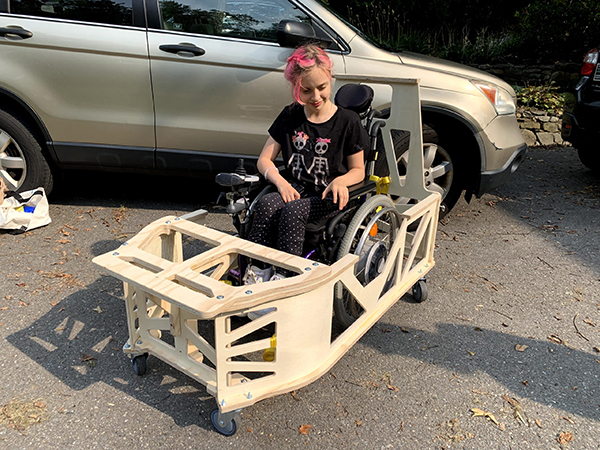
Previous collaboration between SolidWorks user community members and Magic Wheelchair resulted in a series of custom wheelchairs designed to fit the characters and personalities of a select group of children. They included a movable throne, inspired by the "Be our guest" song from Beauty and the Beast; and a Star Wars-themed wheelchair, inspired by the Star Wars Mandalorian.
During the pandemic, the team went to work on Freyja's castle-carriage-wheelchair, drawn by a pair of fantastic beasts. The team used 3DSwym, a social media-style collaboration platform by Dassault Systemes. Here, concept sketches slowly began to take shape.
The primary 3D modeling was done in SOLIDWORKS CAD. "We used SOLIDWORKS CAD to generate the G-code that was needed for machining the different pieces. A lot of the elements for the costume came to life because we had the G-code," Annie said in the YouTube SOLIDWORKS Live event.
For the army of winged fairies and dragonflies, the team 3D printed them and magnetically mounted them, with embedded RFID tags and lights to turn them on and off as desired. "We needed to use SLA printing, which can capture a lot of the smaller details," said Annie.
The dragonflies were modeled from scratch in xShape, a 3D sculpting program. "You basically start with a digital piece of clay, then push and pull it," recounted Jordan Tadic, Senior Solution Consultant, SolidWorks.
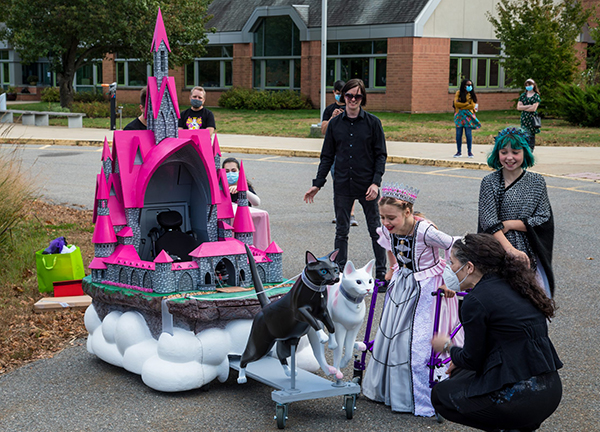
Perhaps the most prominent features of Freyja's carriage are the two giant cats drawing it. Those two giants (each about one-third the size of Freyja herself) were also modeled in xShape by Rob Jost, Senior Manager, Product Definition, SolidWorks. "The subdivision command really helped me, especially around the eyes," he said.
The creatures were much too big to fit into a 3D printer's typical print chamber, so they were printed as separate pieces. "I counted them. There were 53 different body parts for the cats," verified Jost.
The carriage was unveiled to Freyja and her family during her tenth birthday, in front of her party guests. She named her carriage-drawing cats Annie and Christine.
For an interview with the SolidWorks team and Freyja, see the video below.


Dassault Systèmes, the 3DEXPERIENCE Company, is a catalyst for human progress. We provide business and people with collaborative virtual environments to imagine sustainable innovations. The 3DEXPERIENCE platform enables companies to create and…

Electrum utilizes the 3DEXPERIENCE platform on the cloud to develop their new electric motorcycle
Electrum, a new brand of electric motorcycles, utilizes the 3DEXPERIENCE platform. Their mission is to support Indonesia’s shift to low-carbon, sustainable transport and to ultimately help the country’s government achieve its vision of net zero carbon emissions by 2060.

Kenneth Wong is Digital Engineering's resident blogger and senior editor. Email him at [email protected] or share your thoughts or suggestions at digitaleng.news/facebook.
Follow DE
Join over 90,000 engineering professionals who get fresh engineering news as soon as it is published.






About Us · Contact Us · Editorial Team · Advertising · Privacy Policy · Subscriber Services · © 2026 Digital Engineering 24/7 · Peerless Media