Helping design and engineering professionals discover, evaluate and specify technologies and processes that shorten the design cycle and enable success.


Alert!
Digital Engineering ceased publication on July 1, 2026. This website remains available as an archive of engineering content.
For inquiries or information, please email [email protected].

May 2026 Special Focus: Artificial Intelligence in Design and Simulation
In this Special Focus Issue, learn about the latest developments in the integration of artificial intelligence into engineering workflows.

Design & Simulation Software Guide 2025
In this Special Issue, Digital Engineering presents its second annual guide to design and simulation software vendors.
What does climbing Mount Everest have to do with simulation?
Plenty, as it turns out. There are many parallels, especially given the theme of this year’s STAR Global Conference: Simulating Systems. Bringing together disparate engineering disciplines, technologies and stakeholders to accurately simulate systems requires communication and collaboration. In the end, teamwork is as important as the simulation software.
@CD_adapco Keynote is mountaineer & filmmaker David Breashears on teamwork & system #simulation #starglobal pic.twitter.com/mhE8vWCX1O— Desktop Engineering (@DEeditor) March 17, 2014
Breashears has climbed Mount Everest five times, including in 1996 when he led the team that put the first IMAX camera on the summit after surviving a terrible blizzard that killed eight climbers from other teams. His success was the result of choosing a team of equals who could communicate with one another to break down the silos of information that exist in every organization.
For a taste of the challenges they faced, watch the movie clip below.
“Silos are ineffective, they’re obsolete and they just lead to poor performance,” Breashears said. “Sadly, I’ve seen both the blood on the ground of what happens when things go wrong and people don’t talk to each other and people don’t prepare correctly … and I’ve seen the wonderful glory and magnificent joy when we all work together and talk to each other and have the proper resources. When we all stand on top of that mountain, triumphant.”
In filmmaking, silos typically take shape around camera, lighting, makeup and costumes, rather than IT, design, analysis, executives and others who all need to work together to successfully simulate systems. But Breashears’ assessment of — and solution to — problems caused by a lack of communication among silos is universal.
“They have such high levels of expertise in each category, that they don’t know how to have a dialog with another group,” he says of typical silos. “Every corporation suffers from this, and yet it’s not that difficult a problem to solve. It’s as simple as being curious, and wanting to know what your teammates and colleagues are doing and how they’re doing it.”
When it comes to climbing Mount Everest (a mountain climbers often prepare for by breaking their toothbrushes in half to save weight) with a 44-lb. IMAX camera, 12 lb. of film and a 66-lb. tripod, communication is everything.
Breashears created a "team of equals" to scale & film Everest. This shows gear just for the film team. #starglobal pic.twitter.com/0z8AH7WRq2— Desktop Engineering (@DEeditor) March 17, 2014
CD-adapco is integrating those lines of communication within its products, as well as establishing them with its customers.
“All our product actually do interact with each other,” said Jean-Claude Ercolanelli, senior vice president, Product Management, at CD-adapco, when he took the stage after Breashears. “The most interesting part of it is communicating the data between all our tools and other solutions too.”
The company is building off its acquisition of Red Cedar Technology Inc. last year. Red Cedar’s HEEDS Multidisciplinary Design Optimization software is a general purpose process automation and design optimization tool. It can be coupled with CD-adapco’s simulation products, such as STAR-CCM+, STAR-CD, Battery Design Studio and SPEED to pass data among them. It can also be used with other computer-aided-design or computer-aided engineering software engineers may use to speed up the entire design optimization process.
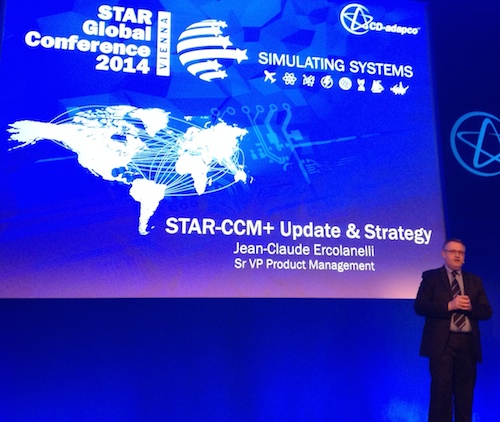
Ercolanelli said the company has a strong commitment to linking CD-adapco’s products together, but also in communicating with customers via its Steve portal and IdeaStorm
The company’s Steve portal is designed to help with customer support. Customers can open support cases, communicate with their dedicated support engineer at CD-adapco and track the progress of their case through to resolution. Since it launched about a year and a half ago, Ercolanelli said the portal:
CD-adapco’s communication with its customers allows it to focus its efforts on the most-wanted improvements. For the latest version of STAR-CCM+, those improvements revolve around adding realism to simulations, smoothing out workflows, increasing throughput and improving accuracy, Ercolanelli said.

Some of the highlights of STAR-CCM+ v9.02 include:
Before Breashears took the stage, CD-adapco co-founder and president Steve MacDonald kicked off the conference by outlining the company’s plans for the future.
“This year, 2014, we’ll be a $200-million-a-year business — not necessarily a super profitable one, but a profitable one,” he said. “We’re plowing all of our money back into the development of our code.”
As a result, MacDonald said he expects to be able to announce at next year’s Star Global conference that the company’s code contains the ability to do both finite element analysis and finite volume analysis.
“So if you take a specific problem, it fits better in one of those processes than it does in the other,” he said. “We’re going to have an integrated finite element and finite volume code all in one … It will be able to deal with everybody’s needs.”
Planning for the future and investing in the resources needed to make that future a reality is another parallel to mountain climbing that Breashears touched on during his keynote.
“Hope is not a strategy and hope is not a plan,” he said. “The day that someone tells me on a mountain: ‘I hope things will work out’ is the day I no longer want to stand by their side. Give me a plan, give me a strategy, give me a way to move forward and I will follow you.”


Jamie Gooch is the former editorial director of Digital Engineering.
Follow DE






About Us · Contact Us · Editorial Team · Advertising · Privacy Policy · Subscriber Services · © 2026 Digital Engineering 24/7 · Peerless Media