Helping design and engineering professionals discover, evaluate and specify technologies and processes that shorten the design cycle and enable success.



Digital Engineering April 2026
In the latest issue of Digital Engineering, we take a look at the latest innovations in design for additive manufacturing, including the use of natural language inputs, social media cosplayers, and AI integration. The issue also includes a feature…

January Special Focus Issue: Design for Additive
In this Special Focus Issue of Digital Engineering, learn about the latest advancements in design for additive manufacturing, including new software tools, additive in automotive, custom medical devices, and more.
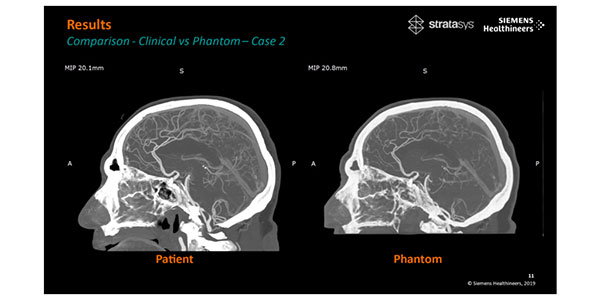
Stratasys Ltd. and Siemens Healthineers recently presented the results of a joint research effort that demonstrates accuracy of the solutions offered by Stratasys to enable 3D-printed medical imaging phantoms to replicate human anatomy, according to Stratasys.
This collaborative effort uses Stratasys’ RadioMatrix materials and Digital Anatomy technology combined with Siemens Healthineers’ advanced algorithms to improve quality of complex anatomy medical imaging phantoms, allowing surgeons, researchers, and educators to replace simplistic anatomical phantom models for presurgery planning and education, the companies report.
This new research demonstrates how anatomically accurate, patient-specific 3D-printed phantoms are scalable and efficient in developing new CT scan algorithms and improving diagnostic precision, Stratasys reports. By using 3D-printed anatomic models for radiology, it is possible to offer a patient-specific, anatomical model that accurately replicates anatomy and pathologies, according to Stratasys.
"The integration of 3D-printing solutions to create patient-realistic CT phantoms, combined with the Digital Anatomy technology from Stratasys, represents a significant innovation in the field of computed tomography,” says Jesús Fernández Léon, head of Computed Tomography Product & Clinical Marketing at Siemens Healthineers. “This cooperation not only enhances our ability to assess and verify the performance of modern CT systems but also ensures that our algorithms can rely on a highly realistic depiction of human anatomy. By working together, we are setting new standards in medical imaging.”
The joint efforts will drive innovation in medical imaging through multiple ways according to Stratasys:
By use of these kind of 3D-printed phantoms, hospitals and imaging centers can enhance the calibration and performance of CT scanners, Stratasys explains, potentially enhancing education, training, and research in radiology, and improving patient outcomes and costs.
“The collaboration between Stratasys and Siemens Healthineers will pave the way for innovations that enhance imaging precision, improve training efficiency, and reduce reliance on cadavers,” says Erez Ben Zvi, vice president of Healthcare, Stratasys. “This is a game-changer for the medical community. We believe this work can speed up the advancement of medicine and improve patient outcomes.”
Sources: Press materials received from the company and additional information gleaned from the company’s website.


Every day, our customers find simpler, smarter approaches to stubborn design problemsand greater confidence to confront towering human and technological challenges. Less hindered by the usual constraints, they can imagine, design, iterate and…

Rapid Prototyping in The Automotive Industry
Henry Ford may not have invented the automobile, but his pioneering spirit did transform the way cars were made. His assembly line process drastically reduced costs with standardized parts and greater efficiency which led to lower cost, higher quality and greater reliability.

DE's editors contribute news and new product announcements to Digital Engineering. Press releases may be sent to them via [email protected].
Follow DE
Join over 90,000 engineering professionals who get fresh engineering news as soon as it is published.






About Us · Contact Us · Editorial Team · Advertising · Privacy Policy · Subscriber Services · © 2026 Digital Engineering 24/7 · Peerless Media