Helping design and engineering professionals discover, evaluate and specify technologies and processes that shorten the design cycle and enable success.



Digital Engineering April 2026
In the latest issue of Digital Engineering, we take a look at the latest innovations in design for additive manufacturing, including the use of natural language inputs, social media cosplayers, and AI integration. The issue also includes a feature…

January Special Focus Issue: Design for Additive
In this Special Focus Issue of Digital Engineering, learn about the latest advancements in design for additive manufacturing, including new software tools, additive in automotive, custom medical devices, and more.
Stratasys Ltd. is sponsoring the University of Minnesota Visible Heart Laboratories with a donation of Stratasys J750 Digital Anatomy 3D printers, as well as MakerBot METHOD X and MakerBot SKETCH 3D printers. The Visible Heart Laboratories are a large research lab located at the University of Minnesota Medical School that supports medical research, student and physician education, and medical device product development and testing.
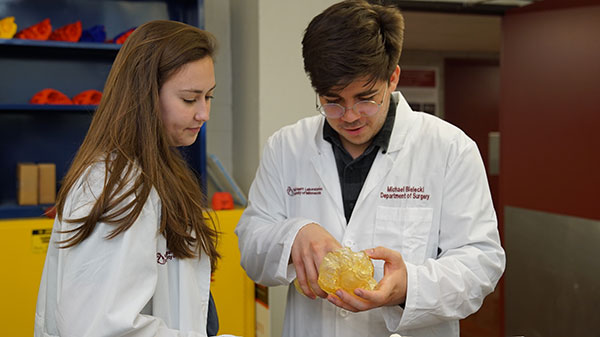
Stratasys’ Digital Anatomy 3D printers produce anatomic models that mimic the actual feel, responsiveness and biomechanics of human anatomy. Models can be punctured, sutured, cut and physically manipulated like actual human tissue. These attributes are especially important to the education, research and product development conducted in the Visible Heart Laboratories.
Al University of Minnesota medical students pass through the Visible Heart Laboratories to learn about 3D printing technology and how anatomic models can assist them in their future practice. The Visible Heart Laboratories also are committed to providing outreach education about cardiac anatomy and device therapy to students from middle school age to clinical cardiologists.
“The Visible Heart Laboratories are driven to train the next generation of medical device developers and provide them with the abilities to 3D print prototypes and/or virtually placed devices within real heart anatomies, as today these are considered essential skills,” says Dr. Paul Iaizzo, professor Visible Heart Laboratories, University of Minnesota Medical School.
In addition to student education, physicians at the M Health Fairview University of Minnesota Medical Center use 3D printing technology to educate patients with anatomic models that represent a patient’s actual anatomy and pathology. Anatomic models can reflect an individual patient’s demographics, comorbidities, or anatomic details like the accumulation of plaque in an artery or the presence of tumors.
With these models, the medical team can describe treatment and surgical options with patients,. 3D printed anatomic models are valuable to physicians when preparing for complex cases or in pediatric cases where the models can be scaled to a size where it is easier for physicians to examine the anatomy. By practicing complex surgeries with 3D printed anatomic models, physicians can determine the best surgical approach for each individual patient.
The 3D printing technology in the Visible Heart Laboratories supports medical device research across various coronary medical device applications. 3D printing technology allows physicians, researchers and medical device product developers to iterate, create and test existing and new medical devices in anatomic models that mimic actual anatomy and pathology.
“We believe that widespread use of 3D printed anatomic models in healthcare would translate into better and more cost-effective patient care and shorter time to market for new medical device innovations. This sponsorship allows us to support the world-class education and medical device research happening right here in Minnesota,” says Rich Garrity, president, Americas for Stratasys. “At Stratasys, we recognize the importance of supporting the communities in which we live and work, and we are proud to support the University of Minnesota Visible Heart Laboratories and the work they are doing.”
The Visible Heart Laboratories also are home to the University of Minnesota Atlas of Human Cardiac Anatomy, a collection of more than 800 human hearts that can be recreated with 3D printing technology for education and medical device testing and development.
“We are thankful for those who have donated their heart to the Visible Heart Laboratories, these gifts have allowed the lab to give the gift of life to others,” says Dr. Iaizzo. “Mixed reality education utilizing high resolution 3D printing greatly impacts our abilities to better educate residents, fellows, medical students, biomedical engineers and many others.”
Sources: Press materials received from the company and additional information gleaned from the company’s website.


Every day, our customers find simpler, smarter approaches to stubborn design problemsand greater confidence to confront towering human and technological challenges. Less hindered by the usual constraints, they can imagine, design, iterate and…
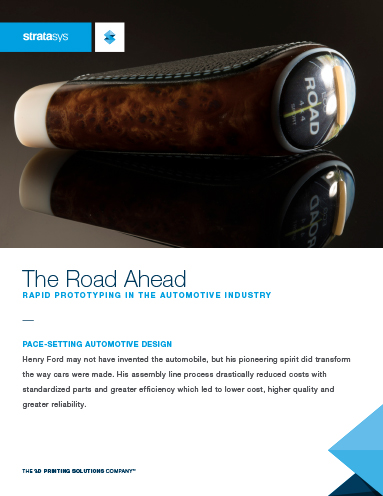
Rapid Prototyping in The Automotive Industry
Henry Ford may not have invented the automobile, but his pioneering spirit did transform the way cars were made. His assembly line process drastically reduced costs with standardized parts and greater efficiency which led to lower cost, higher quality and greater reliability.

DE's editors contribute news and new product announcements to Digital Engineering. Press releases may be sent to them via [email protected].
Follow DE
Join over 90,000 engineering professionals who get fresh engineering news as soon as it is published.






About Us · Contact Us · Editorial Team · Advertising · Privacy Policy · Subscriber Services · © 2026 Digital Engineering 24/7 · Peerless Media