Helping design and engineering professionals discover, evaluate and specify technologies and processes that shorten the design cycle and enable success.



Digital Engineering April 2026
In the latest issue of Digital Engineering, we take a look at the latest innovations in design for additive manufacturing, including the use of natural language inputs, social media cosplayers, and AI integration. The issue also includes a feature…

January Special Focus Issue: Design for Additive
In this Special Focus Issue of Digital Engineering, learn about the latest advancements in design for additive manufacturing, including new software tools, additive in automotive, custom medical devices, and more.
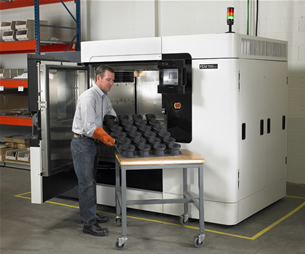 |
Call it putting your money where your mouth is, or is it eating your own dog food? Stratasys (Eden Prairie, MN) is using rapid manufacturing technology to manufacture 32 of the parts in its new large-format rapid prototyping and digital manufacturing system—the FDM 900mc. FDM (fused deposition modeling) is Stratasys’ proprietary process that creates functional prototypes and parts using ABS plastic, polycarbonate, PPSF, and blends.
According to Stratasys, the FDM 900mc machine's touch-screen bezel would have cost an estimated $100,000 for traditional tooling and required a 6-week wait. With rapid manufacturing, production parts can be created on-demand directly from CAD data, so no tooling is necessary. Rapid manufacturing may also prove cost effective when the part is relatively complex or there’s a high likelihood that the design will change.
"Direct digital manufacturing is not for mass production," says Stratasys FDM product manager Patrick Robb. "But if your operations call for limited-run production of certain parts, it’s much more economical than machining or injection molding. Manufacturing engineers can't afford to ignore the savings."
The FDM 900mc features a few departures from previous Stratasys FDM systems. The head gantry is driven by ball screw technology as opposed to previous machines, which are belt driven. This improves predictability and repeatability, according to Stratasys. The resulting positional accuracy and part tolerance are substantially improved over previous systems.
The build envelope of the FDM 900mc is measured in feet, rather than inches—3 ft. x 2 ft. x 3 ft.
Stratasys expects manufacturing engineers in the consumer-product, aerospace, and automotive sectors are expected to be the first adopters of this new technology. The most popular applications are fabrication tools and assembly tools built in the manufacturer's jig and fixture department.
Sources: Press materials received from the company and additional information gleaned from the company's website.


DE's editors contribute news and new product announcements to Digital Engineering. Press releases may be sent to them via [email protected].
Follow DE
Join over 90,000 engineering professionals who get fresh engineering news as soon as it is published.






About Us · Contact Us · Editorial Team · Advertising · Privacy Policy · Subscriber Services · © 2026 Digital Engineering 24/7 · Peerless Media