Helping design and engineering professionals discover, evaluate and specify technologies and processes that shorten the design cycle and enable success.



Digital Engineering April 2026
In the latest issue of Digital Engineering, we take a look at the latest innovations in design for additive manufacturing, including the use of natural language inputs, social media cosplayers, and AI integration. The issue also includes a feature…

January Special Focus Issue: Design for Additive
In this Special Focus Issue of Digital Engineering, learn about the latest advancements in design for additive manufacturing, including new software tools, additive in automotive, custom medical devices, and more.
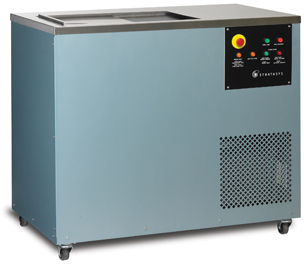 |
Stratasys (Minneapolis, MN) introduced the Smoothing Station, a product that improves the surface finish of ABS-based thermoplastic FDM parts to a surface that is said to be equal to that of an injection-molded part.
What the system’s semi-automated process is capable of is providing a surface finish of 32 to 63 microns. The new process eliminates the need for engineers who require this level of smoothness in an FDM part to manually fill, sand, and paint the part. The combination of a Stratasys FDM additive fabrication system with the new Smoothing Station makes it possible to create injection molded-quality parts in just a few minutes.
The resulting smoothed part has a surface that is suitable for painting, electroplating, vacuum metallization, liquid sealing, and making mold masters such as silicone molding, sand casting, or investment casting.
The Smoothing Station is made up of two interior chambers that together are approximately the size of a small chest freezer. The first chamber treats the thermoplastic part for 15 to 30 seconds to smooth the outer surface of the part. The part is then moved to the second chamber, which holds the part while it cures from the initial process. Within 30 to 45 minutes, parts can be touched, and customers can have fully cured parts within 12 to 18 hours or less.
The system is designed to work with Stratasys ABS-based thermoplastics exclusively, including ABS, ABSi, ABSplus, ABS-M30, and ABS-M30i.
An additional surface-finish product from Stratasys, called the Burnishing Station, can be used in conjunction with the Smoothing Station to give parts a satin or matte finish, blending any small blemishes.
For further information, visit Stratasys.
Sources: Press materials received from the company and additional information gleaned from the company’s website.


DE's editors contribute news and new product announcements to Digital Engineering. Press releases may be sent to them via [email protected].
Follow DE
Join over 90,000 engineering professionals who get fresh engineering news as soon as it is published.






About Us · Contact Us · Editorial Team · Advertising · Privacy Policy · Subscriber Services · © 2026 Digital Engineering 24/7 · Peerless Media