Helping design and engineering professionals discover, evaluate and specify technologies and processes that shorten the design cycle and enable success.



Digital Engineering April 2026
In the latest issue of Digital Engineering, we take a look at the latest innovations in design for additive manufacturing, including the use of natural language inputs, social media cosplayers, and AI integration. The issue also includes a feature…

January Special Focus Issue: Design for Additive
In this Special Focus Issue of Digital Engineering, learn about the latest advancements in design for additive manufacturing, including new software tools, additive in automotive, custom medical devices, and more.
All this, however, may change. Several companies have introduced 3D printing processes that promise voxel-level control, a capability that has the potential to enable AM to cost-effectively take on applications like short-run, end-use parts production. And that could open the door for mainstream adoption of AM technology.
What AM technology needed was the ability to produce injection-molded-quality parts on demand, safely and affordably. This translates into high-resolution, 3D-printed parts with the same strength and surface finish as injection-molded parts. “Achieving this is the holy grail of additive manufacturing,” says Julie Reece, vice president of marketing at Rize.
Voxel-level control allows designers to use a wide variety of construction materials to build customized parts, and it enables predictive voxel-by-voxel corrections to optimize mechanical properties. Armed with these new capabilities, 3D printers can achieve performance levels that manufacturers and engineers have been waiting for a long time.
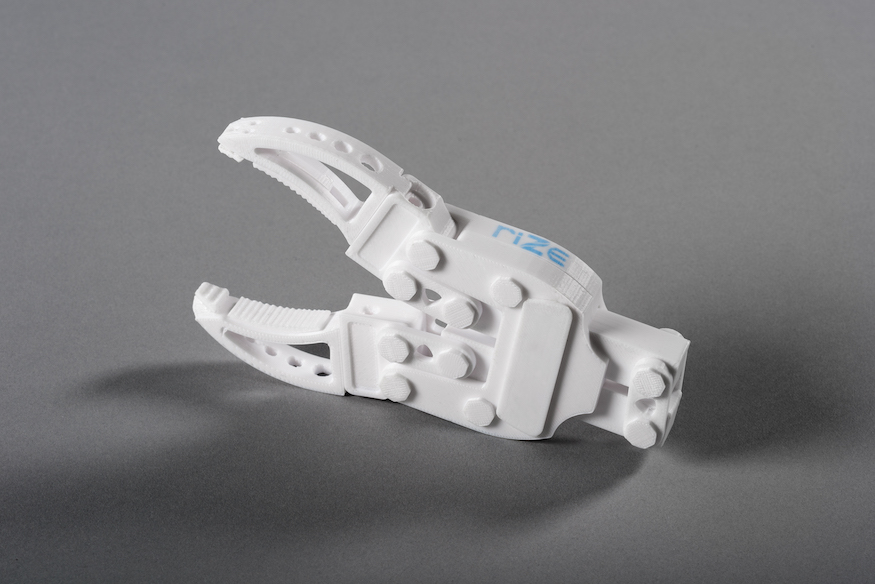
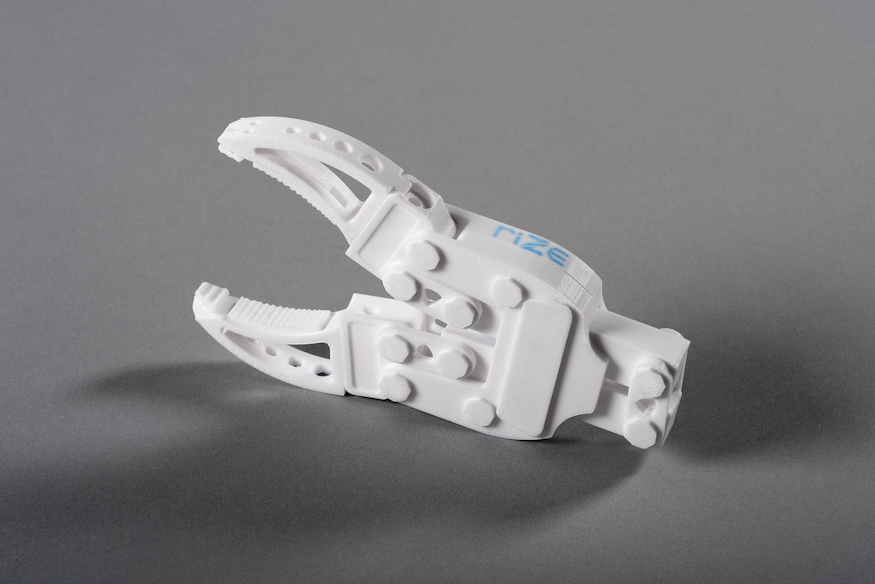 By streamlining post-processing, Rize’s augmented polymer deposition technology opens the door for a new range of applications, including short-run, end-use part production. (Image courtesy of Rize.)
A key ingredient to Rize’s additive process is repelling ink called Release One, which facilitates support removal.
The printer deposits Release One between the print and the support structures, which are made from Rizium One. Release One prevents the two from forming a strong bond. This eliminates the need for bead blasting, super glue baths, high-pressure water jetting, and chemical baths.
Rize estimates that this streamlined post-processing enables users to reduce 3D printing turnaround time by 50%.
“Without post-processing, the value of 3D printing can increase substantially,” says Todd Grimm, founder and president of T. A. Grimm & Associates Inc., an additive manufacturing consultancy. “For some, it will allow them to perform more value-added tasks to improve part quality and expand the application base. For others, it will dramatically accelerate the total process, which increases responsiveness and total throughput. For those adding new 3D printers, eliminating post-processing will reduce labor expense by $25,000 to $50,000 for each machine.”
The impact of streamlining post-processing reaches beyond labor costs and production schedules. Simplifying support removal adds important properties to the APD platform. For example, it allows the Rize One to 3D print with strong thermoplastics (e.g., Rizium One). Because of the way that the material bonds during the printing process, Rizium One is said to retain much of its isotropic properties. This means that the parts printed in this material have nearly the same strength along all axes (X, Y, and Z). This differentiates the Rize One’s performance from many other 3D printing technologies, which cannot create parts with an equally strong Z-axis.
“Post-processing is a non-value-added function that is both a burden and a bottleneck,” says Grimm. “Without it, the promise of a simple, fast, and automated digital workflow becomes a reality for all parts, whether simple or complex in design. In that new reality, 3D printing adoption will accelerate, and the breadth of applications will expand for organizations of all types and sizes and for every industry and market.”
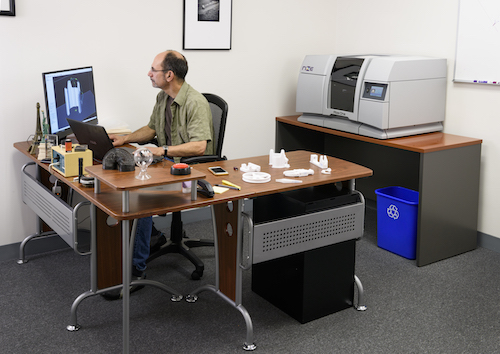 By eliminating any toxic gases or particulates, Rize One clears the way for moving the 3D printer to design engineers’ desktops, enabling greater efficiency and shorter turnaround time. (Image courtesy of Rize.)
“To significantly expand manufacturing applications and markets for 3D printing, the technology must break the chains of the additive manufacturing lab and move into offices, wherever that ‘office’ is located and whatever form it takes,” says Reece.
Reece contends that there is an enormous, unaddressed market for producing customized one-offs and low-volume manufactured end-use parts and tooling on demand, in both lab and non-lab environments. This means moving the printer into the mechanical engineer’s office to make real functional parts; onto the manufacturing floor to make custom tools, replacement jigs, and fixtures on the fly; and into the factory to make spare part replacements on demand rather than in bulk.
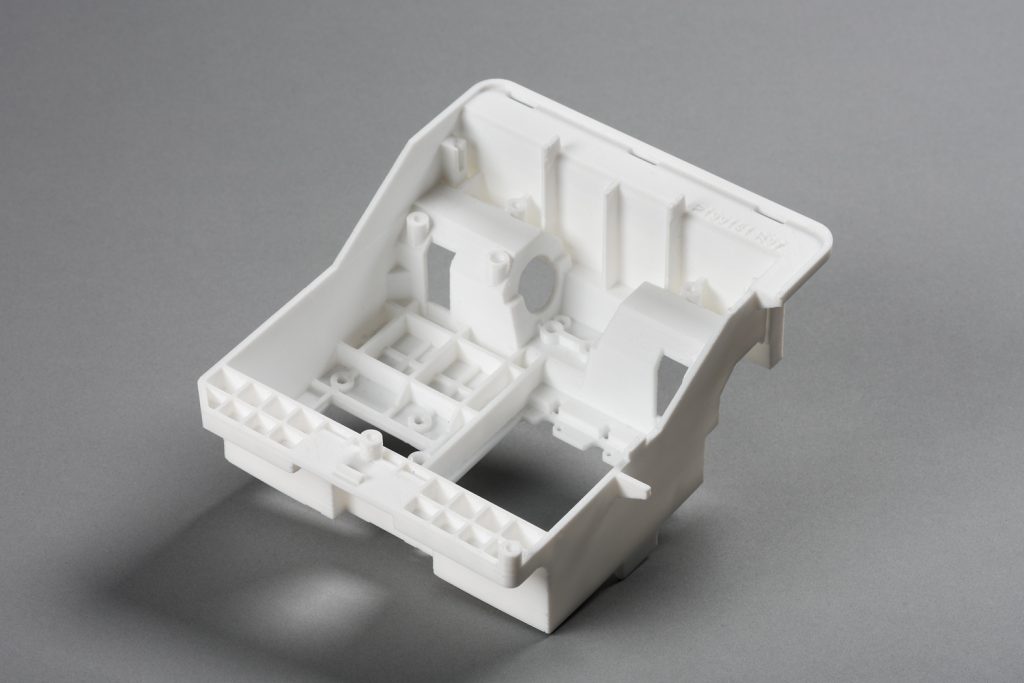 The benefits of Rize’s streamlined post-processing extend even to parts with complex geometries. (Image courtesy of Rize.)
Additive manufacturing has just entered a renaissance period of its evolution. New developments lie just over the horizon, and many of these revolve around the introduction of new materials.
“Rize’s Rizium One thermoplastic and other composite materials and polymers will advance the use of AM for short-run, end-use production parts and products,” says Reece. “For example, nano-filled materials will produce parts with advanced physical properties. Emerging functional inks can change the material properties of polymers to deliver capabilities such as color, thermal conductivity and electrical conductivity. And of course, various metals have become popular over the past year to meet the requirements of niche additive manufacturing applications.”
These material science advances will in turn drive hardware development. Combined, the two forces will increase complexity, but also expand AM’s horizons and utility.


Tom Kevan is a freelance writer/editor specializing in engineering and communications technology. Contact him via [email protected].
Follow DE
Join over 90,000 engineering professionals who get fresh engineering news as soon as it is published.






About Us · Contact Us · Editorial Team · Advertising · Privacy Policy · Subscriber Services · © 2026 Digital Engineering 24/7 · Peerless Media