Helping design and engineering professionals discover, evaluate and specify technologies and processes that shorten the design cycle and enable success.


Alert!
Digital Engineering ceased publication on July 1, 2026. This website remains available as an archive of engineering content.
For inquiries or information, please email [email protected].

Digital Engineering April 2026
In the latest issue of Digital Engineering, we take a look at the latest innovations in design for additive manufacturing, including the use of natural language inputs, social media cosplayers, and AI integration. The issue also includes a feature…

January Special Focus Issue: Design for Additive
In this Special Focus Issue of Digital Engineering, learn about the latest advancements in design for additive manufacturing, including new software tools, additive in automotive, custom medical devices, and more.
A steering shaft bearing made out of a special aluminum alloy (AlSi10Mg) is nearly 50% lighter than the previous component, according to the company. The new steering shaft bearing, designed and printed by Heraeus precisely to the specifications of the TU Darmstadt racing team, now weighs barely 300 grams while maintaining the same mechanical strength and stability.
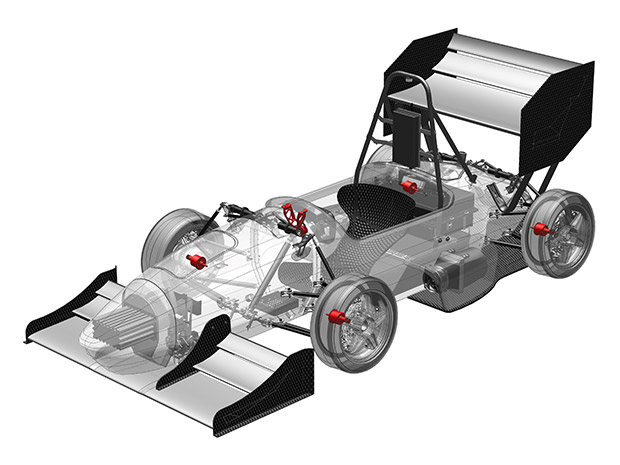 The new TU Darmstadt racecar for the current Formula Student competition contains five ultralight 3D-printed components from Heraeus.
"We completely redesigned the part and optimized it through simulations to achieve the maximum weight reduction. The combination of materials and construction expertise with printing know-how was crucial for reaching this ambitious goal," says Tobias Caspari, head of Heraeus Additive Manufacturing.
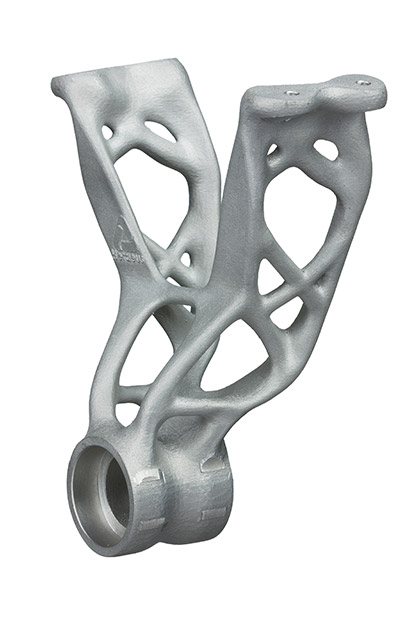 The steering shaft bearing made out of a special aluminum alloy by Heraeus is nearly 50% lighter than the previous component.
For the new TU Darmstadt racecar, the Heraeus team also printed a total of four motor shafts for each wheel suspension, which are 50% lighter than their predecessors. "The Formula Student is a good testing ground for our young development team, where they can test and optimize new designs and materials for additive manufacturing," Caspari says.
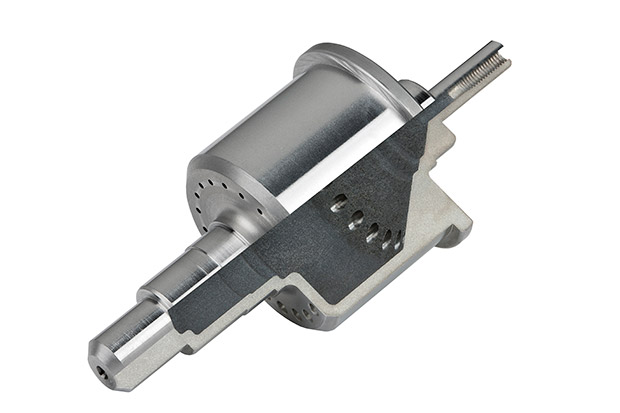 For the new TU Darmstadt racecar, the Heraeus team printed a total of four motor shafts for each wheel suspension, which are 50% lighter than their predecessors.
"Additive manufacturing, which involves building up layer upon layer of metal powders, makes it possible to construct much lighter but still stable functional components with entirely new design possibilities. At the same time, we conserve resources and can recycle any excess powder," says Caspari.
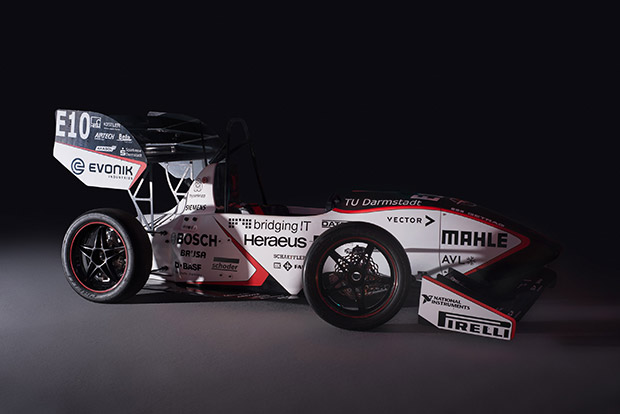 For the racecar 2016 of TU Darmstadt Racing Team 3D-printing products made by Heraeus were already used.
For more info, visit Heraeus.
Sources: Press materials received from the company.






About Us · Contact Us · Editorial Team · Advertising · Privacy Policy · Subscriber Services · © 2026 Digital Engineering 24/7 · Peerless Media