Helping design and engineering professionals discover, evaluate and specify technologies and processes that shorten the design cycle and enable success.


Alert!
Digital Engineering ceased publication on July 1, 2026. This website remains available as an archive of engineering content.
For inquiries or information, please email [email protected].

May 2026 Special Focus: Artificial Intelligence in Design and Simulation
In this Special Focus Issue, learn about the latest developments in the integration of artificial intelligence into engineering workflows.

April 2026 Special Focus Issue: Generative Design
In this Special Focus Issue, Digital Engineering takes a look at how generative design solutions can be used across different types of design problems and with a variety of manufacturing approaches to accelerate design space exploration, and…
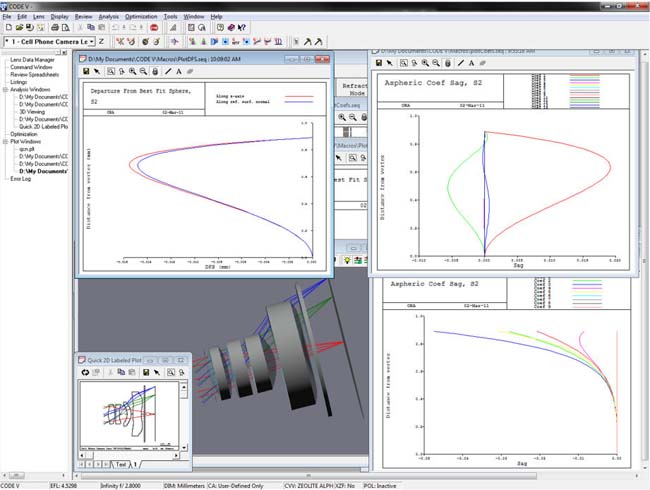
Synopsys, Inc. has announced the availability of enhancements to its CODE V optical design and analysis software. CODE V 10.3 delivers new design and analysis capabilities designed to enable optical designers to more easily take advantage of the image quality and cost benefits that aspheres offer.
 |
Aspheric surface shapes are used to help reduce or eliminate imperfect or blurred images in optical systems. While surfaces with spherical shapes are easier to make, many more spherical surfaces are generally needed to reduce image blurring compared to aspheric surfaces. This means that an aspheric lens can be used to replace multiple spherical lenses, thereby creating a device that is smaller, lighter and potentially less expensive.
“Developments in optical fabrication and metrology are making the use of aspheres in optical design more cost effective,” says George Bayz, vice president and general manager of the Optical Solutions Group at Synopsys. “A key to achieving these cost savings is ensuring during initial design phases that the aspheres can be manufactured as designed. CODE V 10.3 delivers capabilities that help designers add aspheres to a system with the confidence that their designs will be both manufacturable and within budget.”
CODE V 10.3 adds support for new native aspheric surfaces based on mathematical formulations recently published by Dr. G.W. Forbes of QED Technologies. These Q-type aspheric surfaces offer over traditional polynomial-based aspheres for lens design optimization and tolerancing. For example, the Q-type surfaces can be more easily constrained during optimization to improve manufacturability and reduce cost, according to the company.
CODE V’s enhanced surface conversion capabilities are designed to make it easy to switch back and forth between the Q-type formulations and traditional aspheric surface representations. The software’s Asphere Expert tool can save users time by automatically finding optimal asphere locations in the lens system. The tool uses an algorithm that takes into account both aspheric slope departure limits and weighted constraints when computing recommended aspheric surface locations. New built-in optimization constraints in CODE V allow users to directly control the sag or slope variations of Q-type aspheres to maintain manufacturability of the lens system.
For more information, visit Synopsis.
Sources: Press materials received from the company and additional information gleaned from the company's website.


DE's editors contribute news and new product announcements to Digital Engineering. Press releases may be sent to them via [email protected].
Follow DE






About Us · Contact Us · Editorial Team · Advertising · Privacy Policy · Subscriber Services · © 2026 Digital Engineering 24/7 · Peerless Media