Helping design and engineering professionals discover, evaluate and specify technologies and processes that shorten the design cycle and enable success.


Alert!
Digital Engineering ceased publication on July 1, 2026. This website remains available as an archive of engineering content.
For inquiries or information, please email [email protected].

Digital Engineering April 2026
In the latest issue of Digital Engineering, we take a look at the latest innovations in design for additive manufacturing, including the use of natural language inputs, social media cosplayers, and AI integration. The issue also includes a feature…

January Special Focus Issue: Design for Additive
In this Special Focus Issue of Digital Engineering, learn about the latest advancements in design for additive manufacturing, including new software tools, additive in automotive, custom medical devices, and more.
More recently, Taiwan has become something of a high-tech dynamo, producing laptops for Dell, and launching companies with a global impact, such as Acer or HTC. Now Taiwanese industry has turned its attention to additive manufacturing (AM) with the launch of the da Vinci, from the New Kinpo Group, a conglomerate with an emphasis on electronic goods.
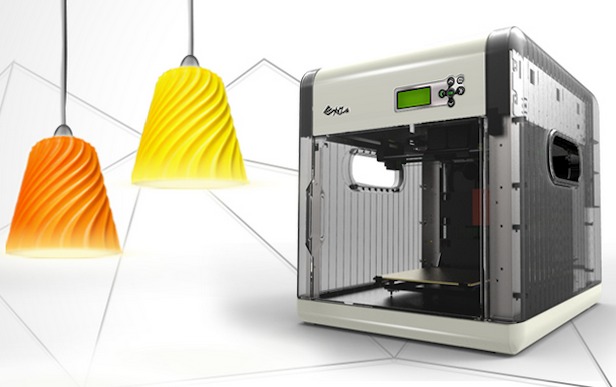
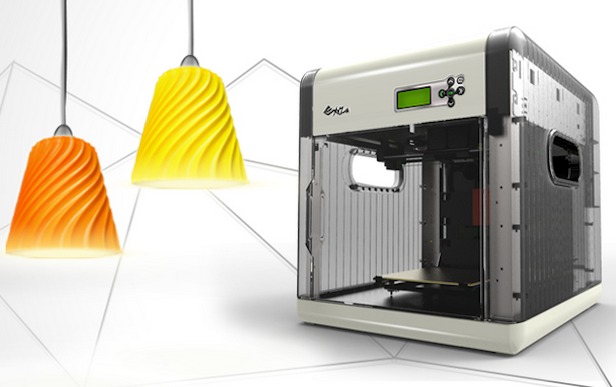
The da Vinci is a pretty standard desktop material extrusion printer (which the company calls fused filament fabrication) with a build envelope of 7.8 x 7.8 x 7.8 in. (20 x 20 x 20 cm). It has a resolution of 100µ and a print speed of 150 mm/s. The new AM system uses 1.75 mm ABS plastic to build objects. If those specs seem familiar, they are almost exactly the same specifications as the MakerBot Replicator 2.
The similarities don’t appear to be coincidental. Simon Shen, New Kinpo Group chairman, specifically called out MakerBot as the manufacturer to beat in the coming year. The Taiwanese company is setting a goal of 100,000 3D printers sold in 2014, establishing itself as a global leader in desktop AM systems. Sales of the da Vinci will be assisted by its price, which has been set at a low, low $499, particularly when compared to the Replicator 2 which sells for $2,199.
There’s some irony to be found in a new company attempting to one up MakerBot with lower prices. The Replicator 2 was developed and priced with the exact same idea in mind. It launched when even moderately priced professional desktop 3D printers were unavailable for less than $9,000. Such a direct challenge becomes even more interesting when you remember MakerBot has recently been absorbed into Stratasys.
New Kinpo Group has plans to launch additional models in the coming year, including a dual-head printer, and an AM system with touchscreen controls. If New Kinpo Group can maintain any sort of quality control over the 3D printers it produces, this could be seen as the first shot in a new pricing war for desktop AM systems.
Below you’ll find a video about the da Vinci. It isn’t in English, but if you’ve watched enough 3D printer launch videos, you don’t even really need to understand what’s being said to get the gist.
Sources: XYZ Printing, WebProNews


John Newman is a Digital Engineering contributor who focuses on 3D printing. Contact him via [email protected] and read his posts on Rapid Ready Technology.
Follow DE






About Us · Contact Us · Editorial Team · Advertising · Privacy Policy · Subscriber Services · © 2026 Digital Engineering 24/7 · Peerless Media