Helping design and engineering professionals discover, evaluate and specify technologies and processes that shorten the design cycle and enable success.


Alert!
Digital Engineering ceased publication on July 1, 2026. This website remains available as an archive of engineering content.
For inquiries or information, please email [email protected].

Digital Engineering April 2026
In the latest issue of Digital Engineering, we take a look at the latest innovations in design for additive manufacturing, including the use of natural language inputs, social media cosplayers, and AI integration. The issue also includes a feature…

January Special Focus Issue: Design for Additive
In this Special Focus Issue of Digital Engineering, learn about the latest advancements in design for additive manufacturing, including new software tools, additive in automotive, custom medical devices, and more.
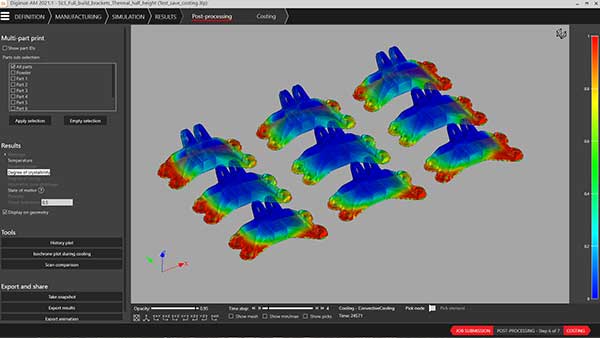
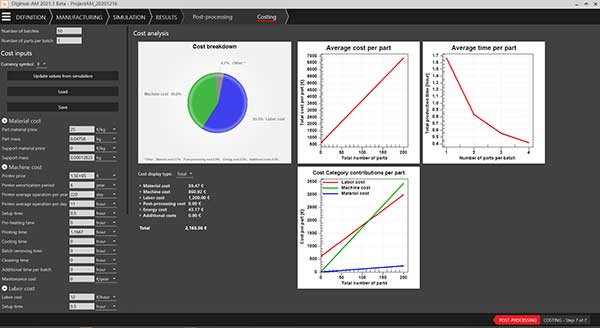
e-Xstream Engineering introduces an update to its Digimat software that features the ability to simulate and analyze production costs of polymer-based additive manufacturing parts against conventional processes. The update includes the use of CT scan data to validate and continuously improve a composite’s microstructure.
e-Xstream Engineering says this new version of Digimat allows an engineer to take a holistic view of part production—including finishing processes—to determine the best method of production. The software can also be used to optimize batch printing, to see if producing parts in parallel using additive manufacturing is a viable solution.
The company says the update also helps with production planning, by comparing the total cost of ownership of machines, amortizing the costs over the production run. The information is presented in visual form with plots and pie charts, making it easier for the engineer to break down cost estimates further and analyze various scenarios.
CT scan data is part of the analysis process. Manufacturers can now CT scan a part and import the RAW 3D image to build a finite element model of the two-phase microstructure in carbon-reinforced polymer, and to model its behavior. The company says that by embedding validated material models in other engineering tools, a design engineer can perform analyses that account for variations within a manufactured part to reduce material use or avoid points of failure.
Using this combination of physical measurement and virtual testing also improves the accuracy of Integrated Computational Materials Engineering (ICME) studies when introducing a new material system. The company says the use of CT scan data also helps validate and certify the material model. The CT scan data is also used to refine manually created microstructure models, thus improving the accuracy of future simulations.
Predicting the material behavior of a CT-scanned microstructure is a computationally intensive process. The company says using only CPUs to analyze the data could take days. Digimat optimizes these processes for GPU technology, allowing tasks to be performed interactively, because the results are produced in minutes.
There is also a significant speed boost when creating a progressive failure analysis (PFA), making it possible to perform these Camanho model analyses twice as fast.
This update to Digimat is now available to existing users directly from e-Xstream Engineering or MSC Software, both part of Hexagon's Manufacturing Intelligence division.
Sources: Press materials received from the company and additional information gleaned from the company’s website.


DE's editors contribute news and new product announcements to Digital Engineering. Press releases may be sent to them via [email protected].
Follow DE






About Us · Contact Us · Editorial Team · Advertising · Privacy Policy · Subscriber Services · © 2026 Digital Engineering 24/7 · Peerless Media