Helping design and engineering professionals discover, evaluate and specify technologies and processes that shorten the design cycle and enable success.



Digital Engineering April 2026
In the latest issue of Digital Engineering, we take a look at the latest innovations in design for additive manufacturing, including the use of natural language inputs, social media cosplayers, and AI integration. The issue also includes a feature…

January Special Focus Issue: Design for Additive
In this Special Focus Issue of Digital Engineering, learn about the latest advancements in design for additive manufacturing, including new software tools, additive in automotive, custom medical devices, and more.
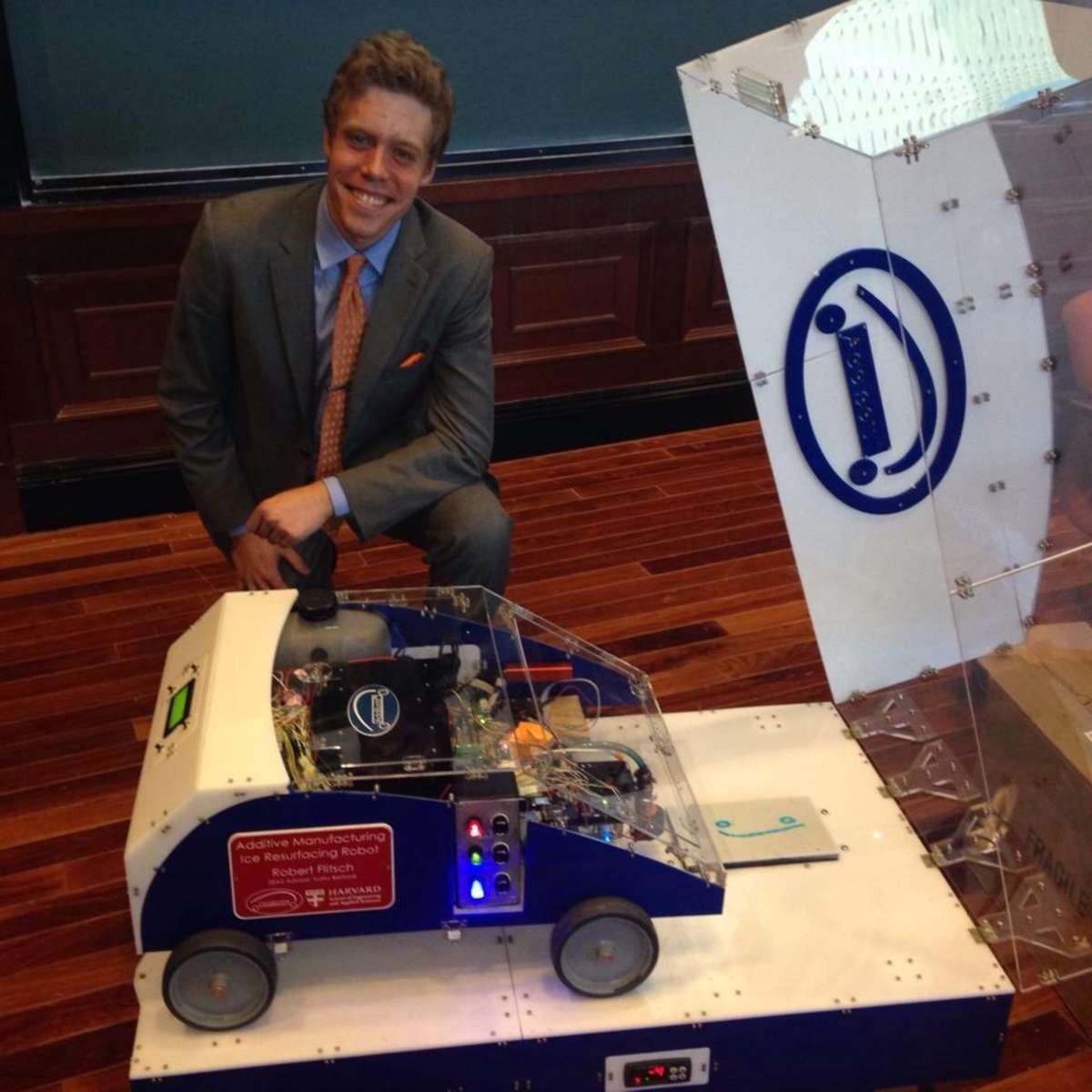
The only thing worse than a pothole large enough to swallow a smart car is the traffic-disrupting heavy equipment brought in to fix the holes. The drivers of seasonal climes need a hero, and that hero may have appeared in the form of a 3D printing robot called Addibot. Developed by Robert Flitsch, a Harvard grad, Addibot could usher in a future of 3D printed road repair.
 The Addibot with its creator Robert Flitsch. Courtesy of Harvard.
Saving drivers from hours of frustration or the expense of new tires wasn’t the Flitsch’s original intent. A lifelong hockey fan, Flitsch originally designed the Addibot as an autonomous Zamboni-like ice resurfacing machine. He envisioned the little machine wandering around an ice rink filling the scrapes made by skaters. Flitsch soon realized a mobile 3D printing unit could complete other, perhaps more profitable, tasks.
“By making the additive manufacturing components completely mobile, you break free of all the workspace limitations of 3D printing,” Flitsch said. “But Addibots also greatly open the field to many new application spaces for additive manufacturing.”
Instead of squirting near-freezing water into scrapes, Flitsch is attempting to redesign the robot to work with tar and asphalt. In place of workers simply dumping loose material into a pothole or crack and smoothing it down, Addibot could insert material that conforms to the dimensions of a hole and fill it with layers of material that (hopefully) won’t simply get torn back out the next time a snow plow drives past.
The biggest obstacles to transitioning the Addibot from ice to asphalt are temperature and material bulk. Flitsch needs to redesign the system to work with hot materials, rather than cold ones. He also needs to come up with some sort of complimentary system capable of toting around large quantities of street repair materials.
Below you’ll find a short video about the Addibot.
Source: Harvard


John Newman is a Digital Engineering contributor who focuses on 3D printing. Contact him via [email protected] and read his posts on Rapid Ready Technology.
Follow DE
Join over 90,000 engineering professionals who get fresh engineering news as soon as it is published.






About Us · Contact Us · Editorial Team · Advertising · Privacy Policy · Subscriber Services · © 2026 Digital Engineering 24/7 · Peerless Media