Helping design and engineering professionals discover, evaluate and specify technologies and processes that shorten the design cycle and enable success.


Alert!
Digital Engineering ceased publication on July 1, 2026. This website remains available as an archive of engineering content.
For inquiries or information, please email [email protected].

Digital Engineering April 2026
In the latest issue of Digital Engineering, we take a look at the latest innovations in design for additive manufacturing, including the use of natural language inputs, social media cosplayers, and AI integration. The issue also includes a feature…

January Special Focus Issue: Design for Additive
In this Special Focus Issue of Digital Engineering, learn about the latest advancements in design for additive manufacturing, including new software tools, additive in automotive, custom medical devices, and more.
Robots have been a growing part of our world since the first bot took its place on the assembly lines at General Motors in 1961. That’s not even counting robots in science fiction. Even pre-industrial societies had ideas about automatons in various guises, such as the Golem of Prague. Recent innovations have put robots in Amazon warehouses and I’m sure you heard something about a robot on Mars.
With all of this "robot-ization" going on, you’d think we’d have more of the things around the house or in use for small businesses. Regardless of advances since 1961, robots are still expensive to design, build and code. The National Science Foundation (NSF) hopes to alleviate that expense with its $10 million project: “An Expedition in Computing for Compiling Printable Programmable Machines.”
The research team for the project pulls together experts from MIT, the University of Pennsylvania and Harvard University. Their goal is to create a system that allows the rapid construction of simple, inexpensive robots.
Our goal is to develop technology that enables anyone to manufacture their own customized robot. This is truly a game changer. It could allow for the rapid design and manufacture of customized goods, and change the way we teach science and technology in high schools.– Professor Vijay Kumar, University of Pennsylvania
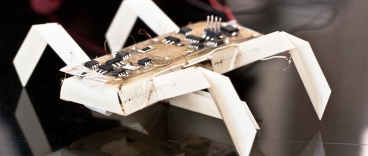
The team is busy at work writing code that governs robot behavior, along with developing an easy-to-use interface. To create bodies for all that code, the team is looking into developing new types of programmable materials. While the simplest robot could be created from a sort of PCB paper, applications that require more robust machines could take advantage of additive manufacturing.
When the program is finished, the team hopes people will be able to shop for robots by selecting from a library of possible builds (similar to Thingiverse), and then simply order their new robot from a nearby printing service. If Thingiverse is any indicator of how quickly open source communities can grow, these online libraries of designs could become large enough that even technologically challenged individuals could find use for a robot.
“This project aims to dramatically reduce the development time for a variety of useful robots, opening the doors to potential applications in manufacturing, education, personalized health care and even disaster relief,” says Rob Wood, an associate professor at Harvard University.
Below you’ll find a short video about the NSF project.
Source: MIT News


John Newman is a Digital Engineering contributor who focuses on 3D printing. Contact him via [email protected] and read his posts on Rapid Ready Technology.
Follow DE






About Us · Contact Us · Editorial Team · Advertising · Privacy Policy · Subscriber Services · © 2026 Digital Engineering 24/7 · Peerless Media