Helping design and engineering professionals discover, evaluate and specify technologies and processes that shorten the design cycle and enable success.


Alert!
Digital Engineering ceased publication on July 1, 2026. This website remains available as an archive of engineering content.
For inquiries or information, please email [email protected].

Digital Engineering April 2026
In the latest issue of Digital Engineering, we take a look at the latest innovations in design for additive manufacturing, including the use of natural language inputs, social media cosplayers, and AI integration. The issue also includes a feature…

January Special Focus Issue: Design for Additive
In this Special Focus Issue of Digital Engineering, learn about the latest advancements in design for additive manufacturing, including new software tools, additive in automotive, custom medical devices, and more.
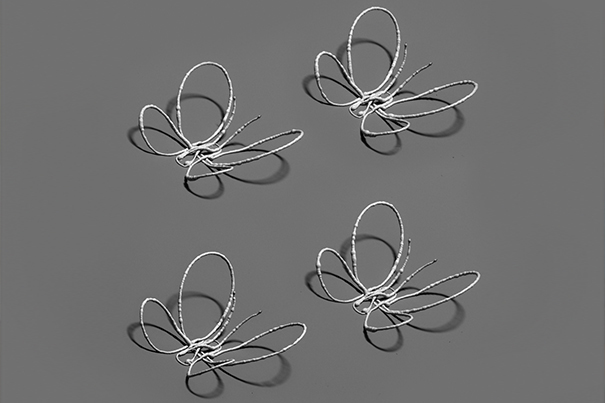
At least that used to be the case. A few AM projects are moving toward more freeform applications that eschew standard forms of 3D printing in favor of an approach that allows for even more design flexibility. Harvard researchers have added some momentum to that approach with a new process that allows for freeform metal printing without requiring support structures.
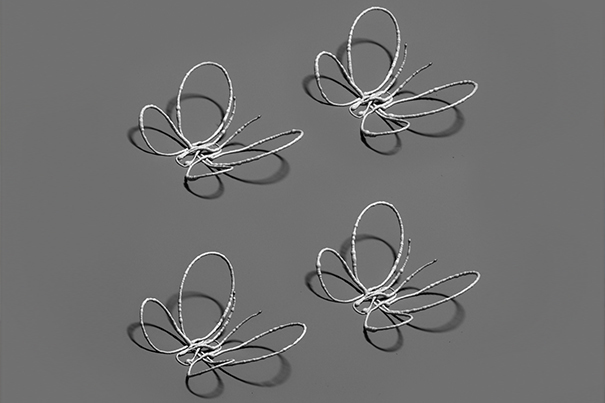 These silver butterflies were 3D printed without requiring support structures. Courtesy of Lewis Lab/Wyss Institute at Harvard University.
The new process is the result of collaboration between Harvard’s Wyss Institute for Biologically Inspired Engineering and the John A. Paulson School of Engineering and Applied Sciences. The initial trials used an “ink” of silver nanoparticles that is pumped through an extruder head. A laser solidifies the ink in place as it leaves the head, allowing for the creation of three dimensional objects in open space.
Along with the potential to build objects without requiring support structures, the new metal used in the new process is conductive. Combined with the nearly negligible amount of heat used in the process, this allows fine silver wires to be printed directly onto low quality or flexible plastics. According to the research team, the biggest obstacle in developing the process was fine tuning the required distance between laser and nozzle.
“If the laser gets too close to the nozzle during printing, heat is conducted upstream, which clogs the nozzle with solidified ink,” said Mark Skylar-Scott, Wyss Institute Postdoctoral Fellow. “To address this, we devised a heat transfer model to account for temperature distribution along a given silver-wire pattern, allowing us to modulate the printing speed and distance between the nozzle and laser to elegantly control the laser annealing process ‘on the fly.’”
Results of the research have been published at PNAS under the title “Laser-assisted direct ink writing of planar and 3D metal architectures.” Potential applications include customizable electronics and biomedical devices. Below you’ll find a video about the project.
Source: Harvard


John Newman is a Digital Engineering contributor who focuses on 3D printing. Contact him via [email protected] and read his posts on Rapid Ready Technology.
Follow DE






About Us · Contact Us · Editorial Team · Advertising · Privacy Policy · Subscriber Services · © 2026 Digital Engineering 24/7 · Peerless Media