Helping design and engineering professionals discover, evaluate and specify technologies and processes that shorten the design cycle and enable success.



May 2026 Special Focus: Artificial Intelligence in Design and Simulation
In this Special Focus Issue, learn about the latest developments in the integration of artificial intelligence into engineering workflows.

April 2026 Special Focus Issue: Generative Design
In this Special Focus Issue, Digital Engineering takes a look at how generative design solutions can be used across different types of design problems and with a variety of manufacturing approaches to accelerate design space exploration, and…
Two months ago, a 54-year-old Spanish man went into surgery at Salamanca University Hospital for chest wall sarcoma. A cancerous tissue had grown in his chest cavity, encompassing part of his sternum and ribcage. To completely remove the cancerous growth, doctors would have no choice but to remove bone along with tissue.
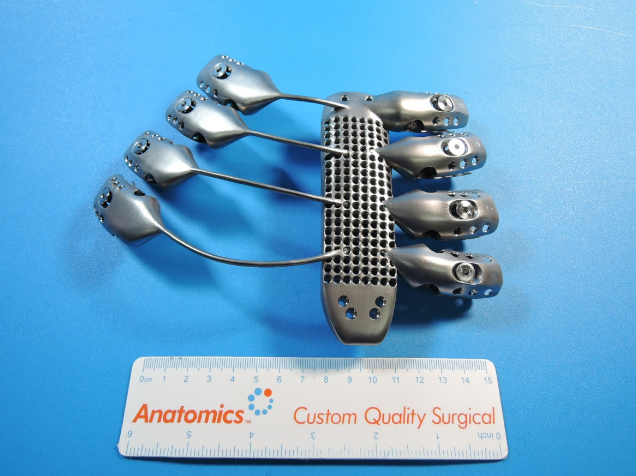
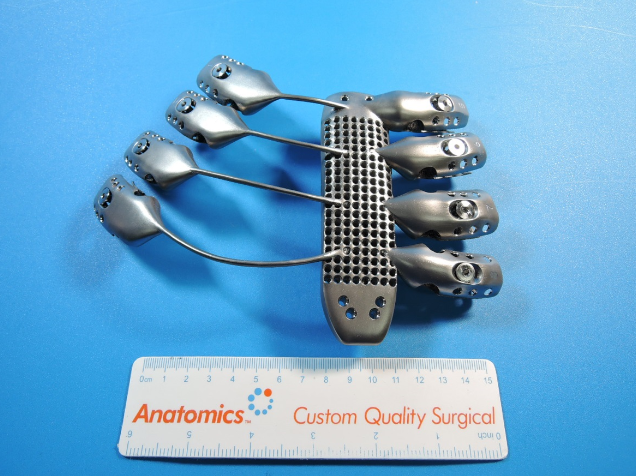 Titanium implant encompassing part of a sternum and ribcage created through additive manufacturing. Courtesy of Anatomics.
Doctors realized what had to be done during the planning and discussed the best manner of creating bone implants to replace the complex skeletal structures they would be forced to remove.
“We thought, maybe we could create a new type of implant that we could fully customize to replicate the intricate structures of the sternum and ribs," said Dr. José Aranda. “We wanted to provide a safer option for our patient, and improve their recovery post-surgery.”
Likely inspired by stories of other successful implants created using AM, the doctors took their idea to Anatomics, an Australian-based company known for its expertise in using data from CT scans to create surgical implants.
“While titanium implants have previously been used in chest surgery, designs have not considered the issues surrounding long-term fixation,” said Andrew Batty, CEO at Anatomics. “Flat and plate implants rely on screws for rigid fixation that may come loose over time. This can increase the risk of complications and the possibility of reoperation.”
Using the data provided by the surgical team, Anatomics created a 3D design consisting of “… a rigid sternal core and semi-flexible titanium rods to act as prosthetic ribs attached to the sternum.” The actual job of printing out the implant was given over to CSIRO and its new Lab 22.
Upon receiving the implant, doctors began surgery and found the titanium ribcage and sternum fit perfectly into place. The surgery was declared a complete success and the patient was discharged after 12 days in the hospital. A description of the procedure has been published in the European Journal of Cardio-Thoracic Surgery.
Below you’ll find a video about the implant.
Source: Anatomics


John Newman is a Digital Engineering contributor who focuses on 3D printing. Contact him via [email protected] and read his posts on Rapid Ready Technology.
Follow DE
Join over 90,000 engineering professionals who get fresh engineering news as soon as it is published.






About Us · Contact Us · Editorial Team · Advertising · Privacy Policy · Subscriber Services · © 2026 Digital Engineering 24/7 · Peerless Media