Helping design and engineering professionals discover, evaluate and specify technologies and processes that shorten the design cycle and enable success.


Alert!
Digital Engineering ceased publication on July 1, 2026. This website remains available as an archive of engineering content.
For inquiries or information, please email [email protected].

Digital Engineering April 2026
In the latest issue of Digital Engineering, we take a look at the latest innovations in design for additive manufacturing, including the use of natural language inputs, social media cosplayers, and AI integration. The issue also includes a feature…

January Special Focus Issue: Design for Additive
In this Special Focus Issue of Digital Engineering, learn about the latest advancements in design for additive manufacturing, including new software tools, additive in automotive, custom medical devices, and more.
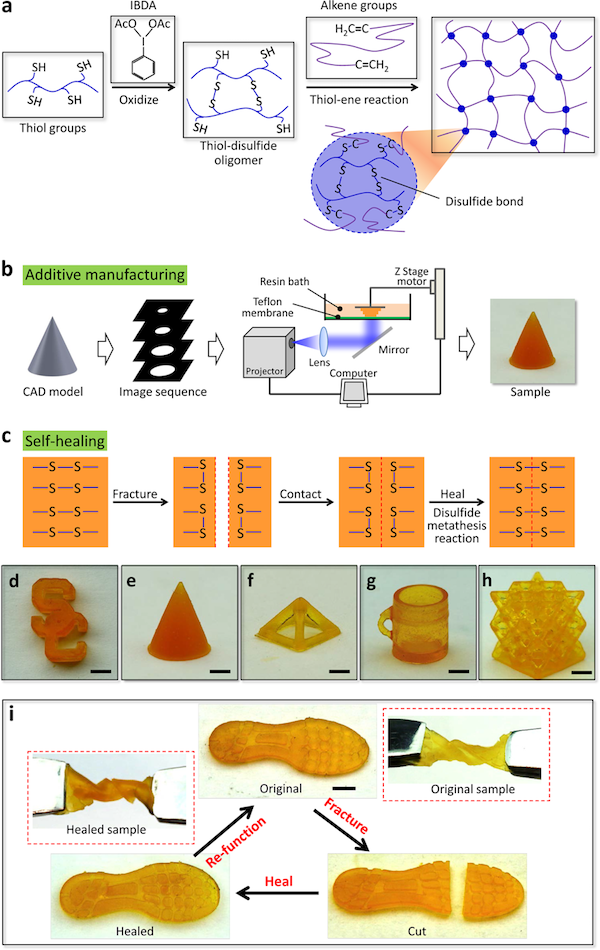
Researchers at the University of Southern California Viterbi School of Engineering have developed 3D-printed rubber material that can repair itself, potentially increasing the longevity of items like tires, shoes, and other items that are frequently fractured or punctured, while decreasing manufacturing time.
Assistant Professor Qiming Wang led the research team. The new material is manufactured with a 3D printing method that uses photopolymerization, a process that uses light to solidify a liquid resin.
The self-healing aspect of the material was achieved by adding an oxidizer to the chemical group (thiols) used in the photopolymerization process, transforming them into disulfides.
"When we gradually increase the oxidant, the self-healing behavior becomes stronger, but the photopolymerization behavior becomes weaker," Wang said. "There is competition between these two behaviors. And eventually we found the ratio that can enable both high self-healing and relatively rapid photopolymerization."
The researchers claim to be able to print a 17.5-millimeter square in just 5 seconds, and can complete whole objects in around 20 minutes. Self-repair can take a few hours.
The study was published in NPG Asia Materials.
According to the researchers: “After being cut in half, in just two hours at 60°C … they healed completely, retaining their strength and function. The repair time can be decreased just by raising the temperature.”
"We actually show that under different temperatures—from 40°C to 60°C—the material can heal to almost 100%," said Viterbi student Kunhao Yu, listed as first-author of the study. "By changing the temperature, we can manipulate the healing speed; even under room temperature the material can still self-heal"
The researchers plan to develop different self-healable materials along a range of stiffnesses, including soft rubber and rigid hard-plastics.
Source: USC


Brian Albright is the editorial director of Digital Engineering.
Contact him at [email protected].






About Us · Contact Us · Editorial Team · Advertising · Privacy Policy · Subscriber Services · © 2026 Digital Engineering 24/7 · Peerless Media