Helping design and engineering professionals discover, evaluate and specify technologies and processes that shorten the design cycle and enable success.



Digital Engineering April 2026
In the latest issue of Digital Engineering, we take a look at the latest innovations in design for additive manufacturing, including the use of natural language inputs, social media cosplayers, and AI integration. The issue also includes a feature…

January Special Focus Issue: Design for Additive
In this Special Focus Issue of Digital Engineering, learn about the latest advancements in design for additive manufacturing, including new software tools, additive in automotive, custom medical devices, and more.
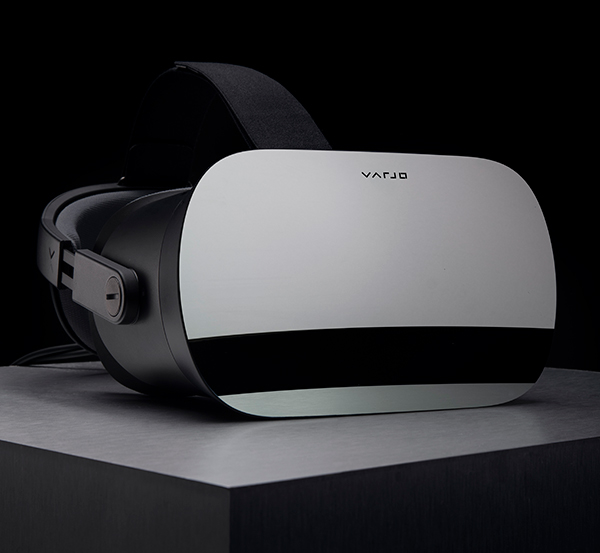
Varjo Technologies announces a human eye-resolution virtual reality device, the Varjo VR-1. The VR-1 is designed solely for professionals in industrial design, training and simulation, architecture, engineering and construction.
Varjo’s first headset has a resolution of more than 60 pixels per degree. VR-1 also comes with integrated eye tracking, enabling analytics and interaction with human-eye resolution VR content.
Varjo’s first product uses optics and patented technology that have been developed over the past two years by the company’s team of 100+ engineers, developers and designers with backgrounds at Nokia, Microsoft, NVIDIA and Intel. Varjo has also collaborated with Early Access partners, including AirBus, Audi, Bohemia Interactive Simulations, Foster & Partners, Saab, Sellen, Volkswagen and Volvo, to optimize the VR-1 for their respective use cases.
Varjo will begin sales and shipping of the VR-1 immediately in 34 countries in North America and Europe as well as Hong Kong. Retailing at $5,995 USD with an additional yearly service license of $995 USD, VR-1 is only available for businesses and academic institutions and is designed to support use scenarios where visual fidelity is needed.
Examples include training pilots in realistic virtual scenes, and allowing designers to create and interact with true-to-life VR prototypes, translating into faster turnarounds and savings in time, work and modeling and development costs. Key features of the Varjo VR-1 include:
Bionic Display. See and create details that were previously unseen. Varjo’s Bionic Display offers human-eye resolution visual fidelity, where every detail, shape, contour, text and surface of a design comes into focus.
20/20 Eye Tracker. With a sub-degree accuracy, Varjo’s 20/20 Eye Tracker is a stereo eye tracking technology integrated into a VR headset, delivering precision and accuracy for interactivity, data collection and analysis in human-eye resolution, according to the company.
Photorealistic virtual workflows. Supporting major professional 3D software tools and engines (already including Unreal®, Unity®, Autodesk® VRED®, PREPAR3D, ZeroLight, and VBS Blue IG), VR-1 offers real-life visual fidelity. A Varjo SDK also enables integration to custom 3D engines.
Varjo has raised a total of $46M USD in funding to start production and global shipping of the VR-1, in cooperation with an Original Device Manufacturing partner, Flex. Later this year, Varjo will introduce a Mixed Reality Add-on to the VR-1, enabling transition between real, virtual and augmented content.
Sources: Press materials received from the company and additional information gleaned from the company’s website.


DE's editors contribute news and new product announcements to Digital Engineering. Press releases may be sent to them via [email protected].
Follow DE
Join over 90,000 engineering professionals who get fresh engineering news as soon as it is published.






About Us · Contact Us · Editorial Team · Advertising · Privacy Policy · Subscriber Services · © 2026 Digital Engineering 24/7 · Peerless Media