Helping design and engineering professionals discover, evaluate and specify technologies and processes that shorten the design cycle and enable success.



May 2026 Special Focus: Artificial Intelligence in Design and Simulation
In this Special Focus Issue, learn about the latest developments in the integration of artificial intelligence into engineering workflows.

April 2026 Special Focus Issue: Generative Design
In this Special Focus Issue, Digital Engineering takes a look at how generative design solutions can be used across different types of design problems and with a variety of manufacturing approaches to accelerate design space exploration, and…
 |
DECS GmbH, based in Thuringia, Germany, are specialists in the design and manufacture of interior and exterior trim composite components for the automotive industry. Its latest project is the Artega GT.
The Artega GT is a mid-engined, rear-wheel-drive, high-performance sports car designed by Henrik Fisker, the man responsible for the Aston Martin Vantage and the sweeping lines of the BMW Z8. The two-seater GT has an aluminium space frame and carbon fiber reinforced body. Providing the power is a Volkswagen-sourced 3.6L V6 engine reaching 60mph in les than 5 seconds.
Within the framework of this project, DECS GmbH have contributed with the manufacture of the front hood, tailgate and roof.
"Artega originally contacted us because we have been involved in a number of projects with other prestige automotive clients and possess the skill and knowledge required for the development of composite components,” says Ulrich Krämer, managing director of DECS GmbH. “For the initial pilot project, we first created five parts using a prototype tool. This must have left a good impression with Artega as we were then invited to participate in the second phase in which we produced a pre-series set of tooling for the front bonnet and tailgate for testing. After successful pre-series testing, we now manufacture the complete suite of production parts for the front bonnet, tailgate and roof."
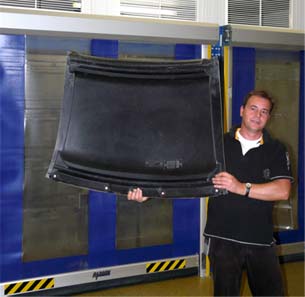 A completed body panel machined using VISI Machining 5-Axis. |
DECS GmbH has developed polyurethane-based composite components using a honeycomb core. Natural fibre-reinforced polyurethanes are being used more and more in the automotive industry and it is now possible to produce parts with wall thicknesses of 1.5 – 2.0 mm, depending on the unit weight of the natural fiber mat used. These end products can weigh about 45% less than products created using conventional injection moulding materials.
One example of process optimization is the use of Huber & Grimme gantry milling machines, which are equipped with two shaft spindles and tandem worktables for multi-axis part trimming. Once the body panels are removed from the tool, they are placed onto jigs and fixtures for part trimming and additional CAM operations. All 5-Axis operations are programmed using VISI Machining from Vero Software and posted using a Siemens 840D controller. NC programs are also simulated prior to running on the shopfloor. The simulation checks against the physical machine limits and ensures process-safe toolpaths.
The relevant jigs and fixtures are also designed using VISI and produced at DECS.
"VISI is the ideal tool for the construction of the trimming jigs," says Ulrich Krämer. "One major advantage is the ability to constantly switch between solid and surface technologies. This is vitally important to us and allows us to follow a flexible design path. VISI provides interfaces to all the significant data formats such as CATIA, UG, Pro E, STEP, IGES and SAT and this allows us to handle our clients native CAD data with confidence."
For more information, visit Vero and Siemens.
Sources: Press materials received from the company and additional information gleaned from the company's website.


DE's editors contribute news and new product announcements to Digital Engineering. Press releases may be sent to them via [email protected].
Follow DE
Join over 90,000 engineering professionals who get fresh engineering news as soon as it is published.






About Us · Contact Us · Editorial Team · Advertising · Privacy Policy · Subscriber Services · © 2026 Digital Engineering 24/7 · Peerless Media