Helping design and engineering professionals discover, evaluate and specify technologies and processes that shorten the design cycle and enable success.



Digital Engineering April 2026
In the latest issue of Digital Engineering, we take a look at the latest innovations in design for additive manufacturing, including the use of natural language inputs, social media cosplayers, and AI integration. The issue also includes a feature…

January Special Focus Issue: Design for Additive
In this Special Focus Issue of Digital Engineering, learn about the latest advancements in design for additive manufacturing, including new software tools, additive in automotive, custom medical devices, and more.
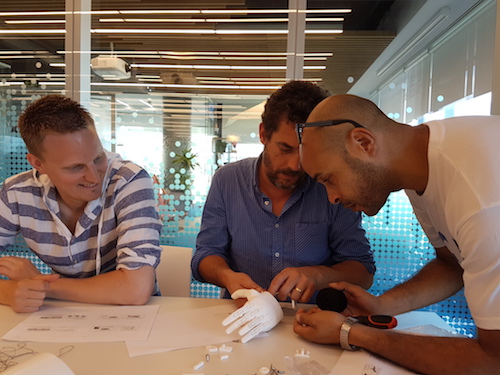
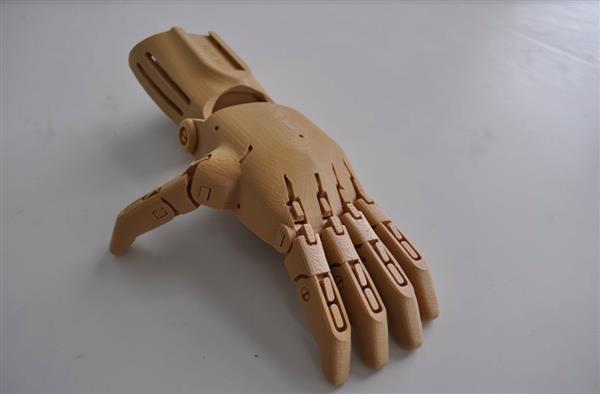 As part of the global hand drive, 22,000 individual hand parts were assembled into 750 prosthetic hands. Image Courtesy of Autodesk
First, some background on the trio of players. ECF is an international network of volunteers committed to leveraging 3D printing technology and STEM programs to create affordable prosthetic devices to serve children and underserved populations around the globe. Autodesk, a giant in the 3D modeling software world, sponsors a community impact program through which it encourages its employees to give back by contributing time and money to good causes. Voodoo Manufacturing is a Brooklyn-based 3D printing services company formed by ex-Makerbot employees, which touts its digital factory approach as a reliable, low-cost method for limited run manufacturing.
The problem the trio set out to solve is giant. In the United States alone, there are nearly 2 million people living with limb loss, according to the Amputee Coalition. The CDC estimates that about 1,500 children are born with congenital upper limb deficiencies every year and 32,500 U.S. kids deal with an amputation due to trauma or disease.
For their recent hand drive, the players came together to design and create 750 printed hands distributed to kids around the globe at a cost of less than $50 per hand. Unlike traditional prosthetics that cost tens of thousands of dollars and can take several weeks or months to produce, these low-cost hands were made of 22,000 individual parts, printed at the Voodoo Manufacturing digital factory over the course of a month and assembled by 10,000 Autodesk employees spread across offices throughout the world.
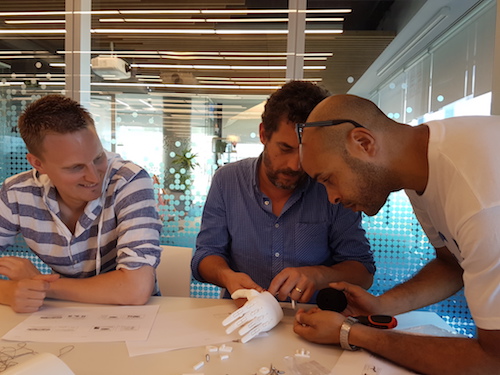 Autodesk employees around the world participated in a 3D printed hand drive. Image Courtesy of Autodesk
Voodoo’s digital factory was a big enabler of the effort, according to Jonathan Schwartz, the company’s co-founder and chief product officer. ECF has traditionally relied on its community to manufacture the parts for the prostheses, an approach that made it difficult to maintain consistency and quality, he explains. “They have a product that’s incredible, and we have a cheaper and more widely accessible way to produce the parts in bulk,” he says.
Unlike 3D printing services bureaus that operate with a handful of really high-end printers, Voodoo’s approach is to leverage 160 Makerbot Replicator2 units working in concert simultaneously to perform a print job.
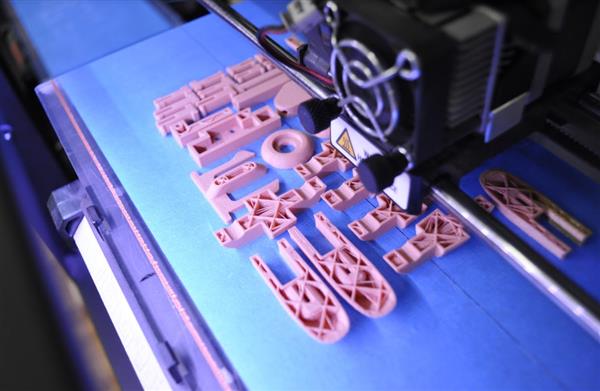 The team enlisted Voodoo Manufacturing’s digital factory, composed of approximately 160 3D printers, in the hand drive effort. Image Courtesy of Voodoo Manufacturing
“We’ve turned 3D printing into a method for viable and economical production of up to 10,000 plastic parts and we can produce them on demand in two weeks or less,” Schwartz says, preferring to draw a comparison to injection molding processes as opposed to high-end 3D printing services. Schwartz says the bulk of Voodoo’s customers fall into two buckets: Those creating brand-specific runs of promotional giveaways and engineering organizations looking for an alternative approach for making lower-volume parts or small-batch runs for prototypes.
Schwartz says the company will continue involvement with ECF and says its 3D printing approach is just what the organization needs to ensure quality and scale. “Before they had to try to find companies or individuals who had 3D printers and round them up to produce any number of the hands they wanted to send to children,” he says. “It was a match made in heaven.”
Check out this video to see the Autodesk team hard at work assembling the prosthetic hands.


Beth Stackpole is a contributing editor to Digital Engineering. Send e-mail about this article to [email protected].
Follow DE
Join over 90,000 engineering professionals who get fresh engineering news as soon as it is published.






About Us · Contact Us · Editorial Team · Advertising · Privacy Policy · Subscriber Services · © 2026 Digital Engineering 24/7 · Peerless Media