Helping design and engineering professionals discover, evaluate and specify technologies and processes that shorten the design cycle and enable success.



Digital Engineering April 2026
In the latest issue of Digital Engineering, we take a look at the latest innovations in design for additive manufacturing, including the use of natural language inputs, social media cosplayers, and AI integration. The issue also includes a feature…

January Special Focus Issue: Design for Additive
In this Special Focus Issue of Digital Engineering, learn about the latest advancements in design for additive manufacturing, including new software tools, additive in automotive, custom medical devices, and more.
Additive manufacturing (AM) has become part of industrial scale production with companies looking to the technology to gain an edge in manufacturing time and waste reduction. The technology has proven itself to be singularly effective even when it isn’t used directly as part of manufacturing.
Volvo has introduced 3D printing to the production floor in the form of 3D-printed tools. Leveraging the power and flexibility of the Stratasys’ Fortus, Volvo has begun to phase out many machined tools that are expensive to produce and replace in favor of 3D-printed tools that are relatively simple and quick to produce, and are less expensive to manufacture.
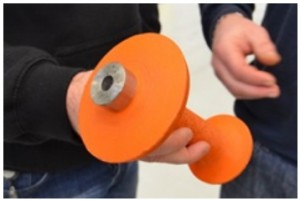 The punch tool was partially constructed using Stratasys' Fortus system. Image courtesy of Stratasys.
According to the company, the tools built using the Fortus have reduced tool part production times by more than 94%. The savings offered by using the 3D printed parts are nearly as impressive. A part built using AM can cost as little as $1.13 per 0.06 cubic inches (1€/cm3), compared to up to $113 per 0.06 cubic inches (100€/cm3) for the same part in metal.
Of course, not every metal part can be replaced with a 3D printed equivalent, but those that can be replaced represent a significant amount of savings in both time and money. Additionally, redesigning old tools, or designing new tools, becomes a great deal simpler using AM.
“Stratasys 3D printing has made an incredible impact to the way we work,” said Pierre Jenny, manufacturing director at Volvo Trucks’ engine production facility in Lyon, France. “The capability to produce a virtually unlimited range of functional tools in such a short timeframe is unprecedented and enables us to be more experimental and inventive to improve production workflow.”
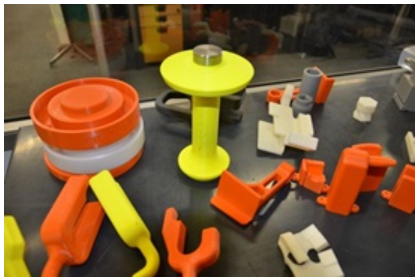
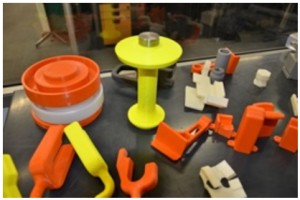 A few of the production tools created on the Fortus system. Image courtesy of Stratasys.
In a little over three months, Volvo leveraged the Fortus to produce over 30 production tools. Uses include clamps, jigs and supports, as well as the occasional odd job to make building automotive parts that much easier. The digital designs for all the new tools remain on file and can be reproduced in a manner of hours if a replacement is called for.
“The fast and cost-effective nature of additive manufacturing means that we are far less restricted than we were even six months ago, allowing us to constantly improve our processes,” said Jean-Marc Robin, technical manager, Volvo Trucks. “We now have operators approaching our 3D print team with individual requests to develop a custom clamp or support tool to assist with a specific production-line issue they might be having. From a time and cost perspective, this is unimaginable with traditional techniques.”
Below you’ll find a video about the Fortus 250mc.
Source: Stratasys


John Newman is a Digital Engineering contributor who focuses on 3D printing. Contact him via [email protected] and read his posts on Rapid Ready Technology.
Follow DE
Join over 90,000 engineering professionals who get fresh engineering news as soon as it is published.






About Us · Contact Us · Editorial Team · Advertising · Privacy Policy · Subscriber Services · © 2026 Digital Engineering 24/7 · Peerless Media