Helping design and engineering professionals discover, evaluate and specify technologies and processes that shorten the design cycle and enable success.



Digital Engineering April 2026
In the latest issue of Digital Engineering, we take a look at the latest innovations in design for additive manufacturing, including the use of natural language inputs, social media cosplayers, and AI integration. The issue also includes a feature…

January Special Focus Issue: Design for Additive
In this Special Focus Issue of Digital Engineering, learn about the latest advancements in design for additive manufacturing, including new software tools, additive in automotive, custom medical devices, and more.
Optical fiber is one such new material, and now WACKER is introducing a process for printing in silicone. The materials breakthrough is the result of working cooperatively with Ingenieure GmbH, a development and prototyping company based in Ergolding, southern Germany.
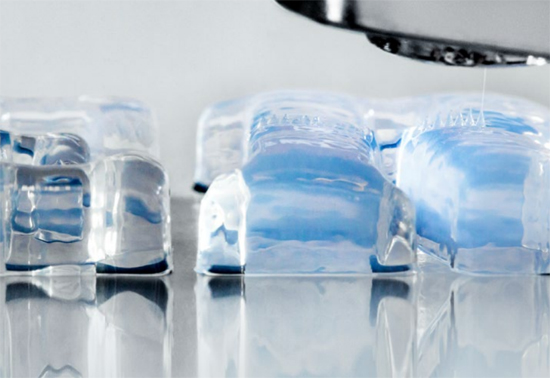 WACKER's silicone printing process build objects in a manner similar to stereolithography. Courtesy of WACKER,
Silicone had previously been considered a poor match for AM as a result of the nature of the 3D printing process. Unlike plastic, silicone can’t simply be melted down and then either extruded or jetted. Prior to the success of the project, injection molding was the best way to work with the material.
“Injection molding is the established process for series production, and will remain so,” said Brend Pachaly, head of silicones research at WACKER. “But people who design prototypes or only want to make a few copies of a part can now very rapidly and flexibly modify such small series to meet changing demands. That is the unique advantage of the process.”
The process developed by WACKER for silicone is vaguely similar to stereolithography. In place of a tub or the standard metal print bed, the new process uses a glass print surface. A silicone material developed specifically for the program is added to the surface in drops and is hardened through exposure to UV light.
Layers of drops are built up until the object is completed, with each layer vulcanizing to the layer below it to create a smooth surface (no strata). The final result, according to the company, is a clear object that is biocompatible and heat resistant.
WACKER foresees a number of different applications for its new technology, including custom silicone respirator masks and hearing aids. It will also be possible to develop a system to manufacture personalized nose pads for eyeglasses as well as the lenses for eyeglasses.
“We have a lot of ideas, and we want to provide our customers with much more than just silicone for additive manufacturing,” added Pachaly. “It will no longer be enough to drop off drums of chemicals in front of the factory hall. In the future, added value will be mainly achieved through comprehensive, customer-oriented solutions.”
Below you’ll find a video about WACKER.
Source: WACKER (.pdf)


John Newman is a Digital Engineering contributor who focuses on 3D printing. Contact him via [email protected] and read his posts on Rapid Ready Technology.
Follow DE
Join over 90,000 engineering professionals who get fresh engineering news as soon as it is published.






About Us · Contact Us · Editorial Team · Advertising · Privacy Policy · Subscriber Services · © 2026 Digital Engineering 24/7 · Peerless Media