Helping design and engineering professionals discover, evaluate and specify technologies and processes that shorten the design cycle and enable success.



Digital Engineering April 2026
In the latest issue of Digital Engineering, we take a look at the latest innovations in design for additive manufacturing, including the use of natural language inputs, social media cosplayers, and AI integration. The issue also includes a feature…

January Special Focus Issue: Design for Additive
In this Special Focus Issue of Digital Engineering, learn about the latest advancements in design for additive manufacturing, including new software tools, additive in automotive, custom medical devices, and more.
With one of the highlights of their academic career spent designing and building racecars, the founders of WAZER know their way around a machine shop. Yet one of the tools that was lacking during their tenure in a University of Pennsylvania student workshop was a waterjet cutter. That's understnadable, given that traditional waterjets take up significant real estate and cost in the ballpark of $100,000.
After spending years coming up with innovative ways to cut sheet metal, the pair of engineering entrepreneurs put their heads together to design a small waterjet as their school project. Fast forward a few years and the team has evolved and commercialized that project, launching the WAZER, a professional-grade waterjet unit that is desktop-sized and priced under $8,000.
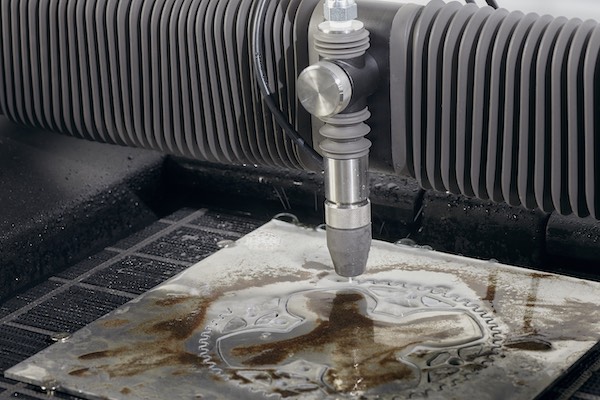
The WAZER’s high-velocity jet employs both high-pressure water spray and sand-like abrasive materials to cut through an array of materials while still achieving a notable level of digital precision. The system, which weighs 110 lbs. and measures 34x25x21 inches, has no special electrical or water requirements. It runs on 110V AC and hooks up to a regular water source like a sink. The unit, aimed at professional designers and smaller manufacturing shops, boasts a cutting area of 12x18 inches, making it well suited for creating prototypes or end-use parts, says Nisan Lerea, WAZER’s co-founder and CEO.
Lerea said WAZER saw an opportunity to create a desktop tool capable of cutting most materials, but that was far easier to use than traditional waterjet units, which needed to be run 24/7 in high-volume production environments to justify their steep price tag.
“We thought if we could scale down and not cut as thick of material and as fast, we could cover the majority of use cases,” he explains. “We focused on making something that had high usability and could support a really simple workflow.”
The WAZER is capable of cutting up to ½-inch aluminum and ¼-inch mild steel.
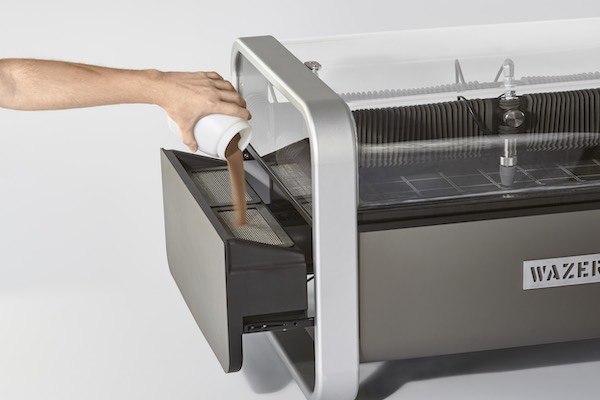
The company’s free web-based software is critical to the ease-of-use experience. Users can set up the design file and go to cutting in about five minutes, Lerea says, and everything is housed in a single enclosure, which makes accessibility easy, including loading fresh abrasion material.
“Holistically, the end result is a machine that has sophisticated processing capabilities, but functions much more like a printer than an industrial tool,” Lerea says.


Beth Stackpole is a contributing editor to Digital Engineering. Send e-mail about this article to [email protected].
Follow DE
Join over 90,000 engineering professionals who get fresh engineering news as soon as it is published.






About Us · Contact Us · Editorial Team · Advertising · Privacy Policy · Subscriber Services · © 2026 Digital Engineering 24/7 · Peerless Media