Helping design and engineering professionals discover, evaluate and specify technologies and processes that shorten the design cycle and enable success.


Alert!
Digital Engineering ceased publication on July 1, 2026. This website remains available as an archive of engineering content.
For inquiries or information, please email [email protected].
Sponsored
 Dear DE Reader:
3D Systems released its ProJet MJP 2500 Series of MultiJet (MJP) 3D printers last spring. Described as affordable, professional-grade systems for concept modeling and design verification applications, these 3D printers also let you fabricate functional prototypes for form and fit testing. A live webinar tomorrow outlined at the other side of today's Check it Out link should provide many insights and demonstrations of their capabilities.
But the webinar's title suggests a goal greater than an equipment demo: “Why Part Quality, Print Speed and Simplicity Matter When It Comes to 3D Printing.” The presenter, Derek Johnson, 3D Systems’ Director of Product Management, did a fine job in an on-demand webinar DE checked in June, so this should be a good show. First, though, let's set the table and fill in any blanks you may have about the ProJet MJP 2500 Series.
This 3D printer series comprises two systems. One model uses durable, rigid white or black plastic materials. The other model extends that capability by enabling you to also fabricate parts with a clear plastic and two elastomeric materials. That’s your difference.
Both ProJet MJP 2500s are office-friendly, high-resolution 3D printers. Key specs include a 11.6x8.3x5.6 in. build envelope and XYZ resolution of 800x900x790 dpi. Typical resolution is ±0.004 in. per inch of part dimension.
OK, that's the gear. So what does 3D Systems mean by quality, speed and simplicity?
3D-printed part quality means a part printed in a plastic and elastomeric material that's a faithful and finely detailed physical representation of your CAD design, as well as a part suitable for function testing. The photo accompanying this message provides a good example of fine details.
As for print speed, 3D Systems says that its ProJet MJP 2500 Series provides up to three times faster print speeds than similar class printers. That means that not only do you get high-quality parts, but you get more of them sooner.
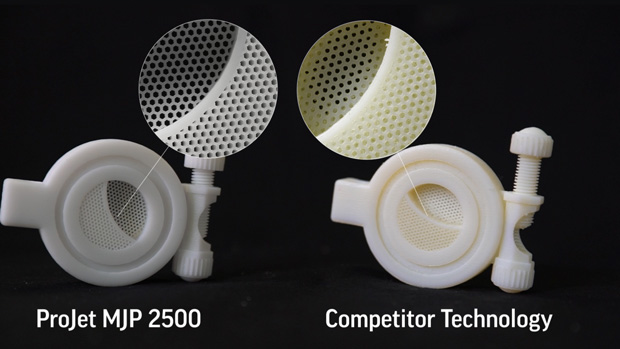 The bearing screen, integrated ball bearing, screw and thread feature in this 3D-printed small housing are among the items to be compared and contrasted in a webinar hosted by 3D Systems. Image courtesy of 3D Systems Inc.
Simplicity describes two things. One, it means powerful yet easy-to-use software to set up and manage print jobs. Two, it means easy and fast removal of support materials.
“Why Part Quality, Print Speed and Simplicity Matter When It Comes to 3D Printing” intends to show you all that. The webinar happens live tomorrow, Wednesday, October 19 at 11 a.m. EST. It’s scheduled to run an hour. Hit today's Check it Out link now to register. If you can’t attend, register anyway to get access to the recording afterwards.
Thanks, Pal. – Lockwood
Anthony J. Lockwood
Editor at Large, DE


DE's editors contribute news and new product announcements to Digital Engineering. Press releases may be sent to them via [email protected].
Follow DE
Join over 90,000 engineering professionals who get fresh engineering news as soon as it is published.






About Us · Contact Us · Editorial Team · Advertising · Privacy Policy · Subscriber Services · © 2026 Digital Engineering 24/7 · Peerless Media