Helping design and engineering professionals discover, evaluate and specify technologies and processes that shorten the design cycle and enable success.


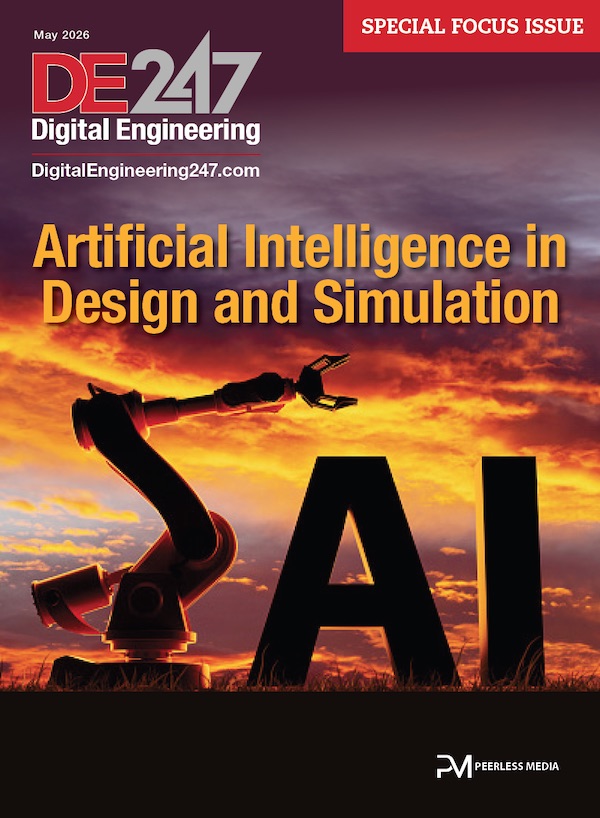
May 2026 Special Focus: Artificial Intelligence in Design and Simulation
In this Special Focus Issue, learn about the latest developments in the integration of artificial intelligence into engineering workflows.

Design & Simulation Software Guide 2025
In this Special Issue, Digital Engineering presents its second annual guide to design and simulation software vendors.
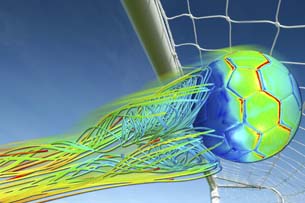 |
Wilson is using CD-adapco’s STAR-CCM+ software on Windows HPC Server 2008 to perform aerodynamics research on its soccer balls.
While the attention of the world focused on soccer balls this summer, Wilson teamed with CD-adapco to redefine computer simulations of soccer ball aerodynamics. During preparations and through the final match of this year's World Cup, FIFA fielded complaints from many players concerned with uncontrollable speed and/or unpredictable flight behavior of the official match ball, which was developed and manufactured by the tournament's primary corporate sponsor.
“Wilson has long realized the importance of aerodynamics in the design of reliable and high-performance golf balls, footballs, soccer balls, basketballs, and baseballs,” says Doug Guenther, Wilson Sporting Goods Co., vice president of Research and Development. "Several factors lead to the choice of CD-adapco and STAR-CCM+. The ability of STAR-CCM+ to accurately and efficiently solve unsteady flows with boundary layer transition was certainly a key technical factor, but equally important is the support and flexibility offered by CD-adapco. Their dedicated support model and Power-on-Demand offering is an ideal solution for our needs."
In the past, most computational fluid dynamics (CFD) studies were limited to fundamental models. This was accomplished by simplifying the details in the shape of the ball and reducing the actual flow physics involved. These simplifications eventually led to inaccurate results, according to the company, forcing ball designers to perform expensive and time-consuming wind tunnel tests.
Using STAR-CCM+ allows Wilson to model the genuine shape of the ball including details such as the panels, seams and stitches. This is important because these geometric details affect the transition of the airflow from laminar to turbulent flow, and this is the critical element to accurately predicting the aerodynamic drag and stability of the ball. The initial phases of the project were executed using Power-on-Demand with computer clusters running Windows HPC Server 2008.
The Power-on-Demand offering from CD-adapco enables Wilson to take advantage of cloud computing when executing the STAR-CCM+ simulations. "Cloud computing is a fantastic cost-effective solution for Wilson, and our Power-on-Demand offering makes it easy to use STAR-CCM+ on the cloud," says David L. Vaughn, vice president of Worldwide Marketing for CD-adapco.
For more information, visit CD-adapco.
Sources: Press materials received from the company and additional information gleaned from the company's website.


DE's editors contribute news and new product announcements to Digital Engineering. Press releases may be sent to them via [email protected].
Follow DE
Join over 90,000 engineering professionals who get fresh engineering news as soon as it is published.






About Us · Contact Us · Editorial Team · Advertising · Privacy Policy · Subscriber Services · © 2026 Digital Engineering 24/7 · Peerless Media