Helping design and engineering professionals discover, evaluate and specify technologies and processes that shorten the design cycle and enable success.


Alert!
Digital Engineering ceased publication on July 1, 2026. This website remains available as an archive of engineering content.
For inquiries or information, please email [email protected].

Cut Retrieval-Augmented Generation (RAG) Hallucinations by 50%
Most teams hit the same wall with enterprise AI: LLMs that hallucinate, pipelines that don’t scale, and infrastructure that’s harder to design than the models themselves.

What Is Intelligent BOM Management? A Guide to Smarter Product Development
Learn how intelligent Bill of Materials (BOM) management helps teams collaborate, reduce errors, and bring innovative products to market faster with cloud-based PLM tools.
BOXX Technologies' just announced APEXX 2 2403 workstation is built around the 7th Generation Intel Core i7 CPU--code-named Kaby Lake--that's been overclocked to 4.8GHz. The APEXX 2 2403 provides “outstanding support” for SOLIDWORKS as well as other CAD and 3D design applications such as AutoCAD, CATIA, Solid Edge, Autodesk Revit, 3ds Max, Maya and Cinema 4D. The company adds that it is the only workstation manufacturer offering the new Intel micro architecture safely overclocked and backed by a three-year warranty.
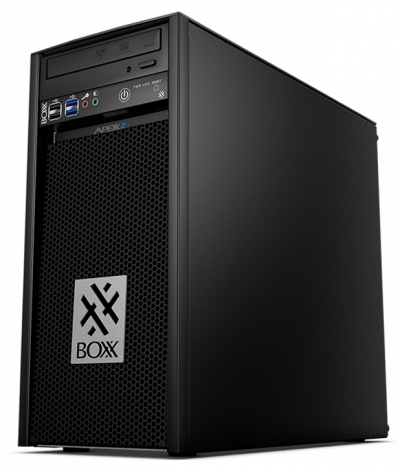 At the heart of the new APEXX 2 Model 2403 engineering workstation is a 7th Generation, quad-core Intel Core i7 7700K processor – code-named Kaby Lake – that's been overclocked to 4.8GHz. Image courtesy of BOXX Technologies.
BOXX reports that the overclocked, 7th Generation Intel Core i7 7700K processor means that the BOXX APEXX 2 2403 is nearly 10% faster than the standard edition APEXX 2 2203 workstation, which offers a base clock speed of 4.2GHz. BOXX adds that the overclocked APEXX 2 2403 sustains the 4.8GHz frequency across all four of the Intel CPU's cores even in the most demanding situations.
The APEXX 2 2403 can be customized with up to 64GB of DDR4-2400MHz memory as well as two full-length NVIDIA or AMD Radeon Pro professional-level graphics cards. It supports up to 8TB of SATA hard drives and 2TB of SSD (solid state drive) storage. The APEXX 2 2403 runs the 64-bit Windows 10 operating system.
The new workstation has a compact 6.85 x 14.6 x 16.6-in. (WxHxD; 17.4 x 45.7 x 51.3-cm) chassis, an advanced liquid cooling system and a 550-watt power supply. Front-panel connections include four USB 3.0 and Audio Out/Mic In ports. Among the connections on the rear are four USB 3.0 ports, two USB 3.1 ports (one each of Type A and Type C), Gigabit Ethernet and DVI/HDMI/VGA.
“The introduction of the new Kaby Lake Intel Core i7 is a significant upgrade for any workstation,” said Shoaib Mohammad, VP of Marketing and Business Development at BOXX, in the press announcement. “But when you add overclocking, the result is the pinnacle in workstation performance.”
In addition to the four-core Intel Core i7 processor overclocked to 4.8GHz, specifications for a recommended basic APEXX 2 2403 configuration include 16GB DDR4-2133 memory, a single 2GB NVIDIA Quadro K620 graphics accelerator, 512GB M.2 PCIe SSD and a removable 20X dual layer DVD+/-RW optical drive. Pricing starts at $3,131.
For more information on the BOXX APEXX 2 2403, click here.
Download the BOXX APEXX 2 2403 spec sheet.
Check out David Cohn's review of an APEXX 2 series workstation.
See why DE's editors selected the BOXX APEXX 2 2403 as their Pick of the Week.
Sources: Press materials received from the company and additional information gleaned from the company's website.


Anthony J. Lockwood is Digital Engineering's founding editor. He is now retired. Contact him via [email protected].
Follow DE






About Us · Contact Us · Editorial Team · Advertising · Privacy Policy · Subscriber Services · © 2026 Digital Engineering 24/7 · Peerless Media