Helping design and engineering professionals discover, evaluate and specify technologies and processes that shorten the design cycle and enable success.


Alert!
Digital Engineering ceased publication on July 1, 2026. This website remains available as an archive of engineering content.
For inquiries or information, please email [email protected].

Digital Engineering April 2026
In the latest issue of Digital Engineering, we take a look at the latest innovations in design for additive manufacturing, including the use of natural language inputs, social media cosplayers, and AI integration. The issue also includes a feature…

January Special Focus Issue: Design for Additive
In this Special Focus Issue of Digital Engineering, learn about the latest advancements in design for additive manufacturing, including new software tools, additive in automotive, custom medical devices, and more.
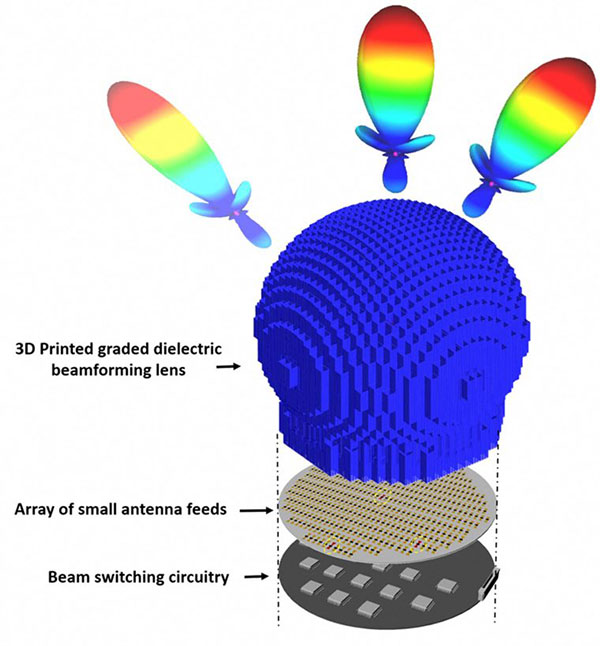
The University of Delaware (UDEL) has installed an XJet Carmel 1400 AM System and will use XJet ceramic 3D printing to develop Passive Beam Steering antenna technology for, among other applications, the 5G network.
The XJet Carmel 1400 AM System, using NanoParticle Jetting (NPJ) technology, helps solve a crucial problem in the roll-out of the 5G network. In comparison to 4G/3G, 5G signals deliver data 10-20 times faster, however they are more sensitive to objects and inference, requiring a vast increase in the number of antennas to solve the issue. Existing antenna technology is simply too expensive to enable the successful scaling up of infrastructure required by 5G, according to the company.
Mark Mirotznik, professor of Electrical Engineering, University of Delaware, says their research team has developed special software and algorithms to enable the design of small, lightweight, cost-effective 5G antennas. The issue facing the university was that, seemingly, no manufacturing process existed to produce the lens with the complex structure, small channels and material properties required.
“Discovering XJet NanoParticle Jetting was a real lightbulb moment for us. In one stroke, it solved our previous frustration in achieving both the material characteristics combined with the geometric properties essential to our solution. NPJ is the only process capable of producing the inner walls of each channel with the accuracy and smoothness required to retain wave direction—but in ceramic. XJet’s ceramic is an isotropic, 100% density ceramic with the right dielectric constant, which does not ‘absorb’ and weaken signal. Quite literally, any tiny variation in tolerance could lead to diversion of the signal to the wrong place, and that couldn’t be afforded,” says Mirotznik.
Research conducted at Youngstown State University (YSU), using the XJet Carmel 1400 system (owned by the Youngstown Business Incubator and operated by the university), further supports the results of the University of Delaware with regards to density, isotropic properties, dielectric constant and the use of XJet for the development of devices such as the 5G antenna.
“We carried out research to establish the nature and properties of XJet printed Zirconia," says Professor Eric MacDonald, Friedman Chair for Manufacturing, YSU. "This suggested the crystal structure of the prints are nearly even; the dielectric constant is high while the loss tangent is low and are both similar to the value expected from a non-printed crystal. This high dielectric constant with low loss opens the potential for 3D printing of a variety of microwave devices including antennas, lenses and filters. Two simple dielectric resonator antennas were demonstrated with the material, showing that the measured material properties can indeed be used for accurate design of such devices with electromagnetic simulation tools.”
“5G is expected to bring about a true revolution in wireless technology, and with it the connectivity to support everything from autonomous vehicles and smart cities, to long-distance surgery, live-streaming virtual reality and the prospect of a limitless Internet of Things,” says XJet CEO Hanan Gothait. “Clearly, to achieve that, the technology must be extraordinarily reliable, and we believe NPJ is ideally placed to deliver it. 5G antennas will need to be produced in the millions to deploy a successful, fully functioning 5G global network—and millions is exactly the kind of productivity this system has been designed for.”


DE's editors contribute news and new product announcements to Digital Engineering. Press releases may be sent to them via [email protected].
Follow DE






About Us · Contact Us · Editorial Team · Advertising · Privacy Policy · Subscriber Services · © 2026 Digital Engineering 24/7 · Peerless Media