Helping design and engineering professionals discover, evaluate and specify technologies and processes that shorten the design cycle and enable success.


Sponsored

Digital Engineering April 2026
In the latest issue of Digital Engineering, we take a look at the latest innovations in design for additive manufacturing, including the use of natural language inputs, social media cosplayers, and AI integration. The issue also includes a feature…

January Special Focus Issue: Design for Additive
In this Special Focus Issue of Digital Engineering, learn about the latest advancements in design for additive manufacturing, including new software tools, additive in automotive, custom medical devices, and more.
Dear Desktop Engineering Reader:
 |
As a Desktop Engineering reader, no doubt you are well aware of what direct digital manufacturing could mean for your company. The problem is that your boss or your boss's boss most likely doesn't get what an investment in DDM could really mean to the bottom line. So, when the subject of DDM comes up, you get blown off with a line that sounds something like “the machine is expensive; how long will it take to pay for itself?”
Sigh. Not that the old ROI question is inappropriate, it's spot on from the fiduciary point of view. Rather, it's that metrics — as in dollars — are what spur on the honchos, and you really do not know a formula to provide a good answer. Well, hard dollars are a key part of today's Check It Out sponsored by Stratasys, and all the data is there for you to engineer the formula to explain why DDM is the right investment for your company. Get a pad and pencil out to take notes.
Today's video and complementary PDF is about Oreck. You've seen their commercials on TV. They've been making vacuums since 1963, and they were an early adopter of DDM in the form of a pair of Stratasys Fortus 3D Production Systems.
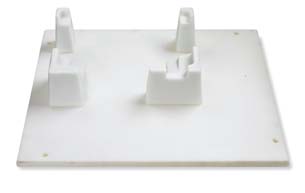
The issue here is that Oreck is both a mass production and low-volume manufacturer. Each of its product lines use some 40 to 50 custom production assembly pallets, which are used to precisely hold things like covers so that the vacuum's guts can be assembled quickly and efficiently.
Now, prior to DDM, Oreck used traditional silicone or epoxy molds and urethane castings with inserts to create these fixtures. The Fortus with its FDM additive build process gave the engineers at Oreck the option to create the fixtures themselves. In fact, Oreck uses the Fortus throughout the enterprise: prototypes, full mockups, specialized assembly tools, and fixtures for their testing stands, CMMs, and CNCs. They even make some of the models you see in ads and TV commercials.
Besides that, what has DDM meant to Oreck? Well, they say that they get a dollar savings of up to 65 percent in fixture production costs (they cite a $100,000 project). Now, do the math for the boss. If you have one or multiple product lines and you could potentially reduce production costs by up to 65 percent with a Fortus 3D Production System, what would that translate to in hard dollars? Then, all you need to do is get pricing from Stratasys, extrapolate savings over time, and figure out the ROI for the boss. The answer might surprise the two of you.
Hit the link over there, see, and read about what DDM has meant for Oreck. Make sure to take notes.
Thanks, pal. -- Lockwood
Anthony J. Lockwood
Editor at Large, Desktop Engineering


Anthony J. Lockwood is Digital Engineering's founding editor. He is now retired. Contact him via [email protected].
Follow DE
Join over 90,000 engineering professionals who get fresh engineering news as soon as it is published.






About Us · Contact Us · Editorial Team · Advertising · Privacy Policy · Subscriber Services · © 2026 Digital Engineering 24/7 · Peerless Media