Helping design and engineering professionals discover, evaluate and specify technologies and processes that shorten the design cycle and enable success.



May 2026 Special Focus: Artificial Intelligence in Design and Simulation
In this Special Focus Issue, learn about the latest developments in the integration of artificial intelligence into engineering workflows.

Design & Simulation Software Guide 2025
In this Special Issue, Digital Engineering presents its second annual guide to design and simulation software vendors.
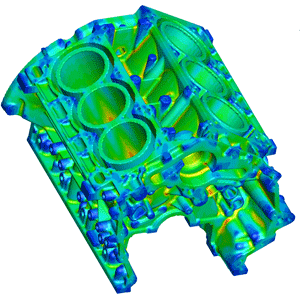 Von Mises stresses in the solidified aluminum V6 engine block. Image courtesy of Flow Science, Inc. |
Flow Science, Inc. (Santa Fe, NM) has announced the availability of a new release of its FLOW-3D computational fluid dynamics (CFD) software. FLOW-3D version 10.0, says the company, features models for fluid structure interaction (FSI) and thermal stress evolution that simulate and analyze the deformations of solid components and solidified fluid regions as well as resulting stresses in response to pressure forces and thermal gradients. The models use a combination of conforming finite-element and structured finite-difference meshes.
Current users will experience a boost in speed with the implementation of SMP parallelization across the board for almost all models in FLOW-3D v10.0, according to the company.
“Version 10 is one of the most important releases in the history of FLOW-3D. The code has advanced tremendously with the addition of the fluid structure interaction and thermal stress models, both of which give our users even more sophisticated and fundamental numerical modeling capabilities,” said Michael Barkhudarov, Flow Science’s vice president of Research and Development, in a press statement.
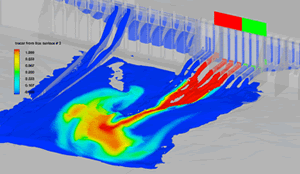 A flow tracer (red) originating at a flux surface. Image courtesy of Flow Science, Inc. |
Key models and improvements include:
FLOW-3D runs on 32-bit and 64-bit x86 Windows and Linux. Simulation size is said to be only limited by the available memory on the computer.
Flow Science has begun shipping FLOW-3D version 10 to users with maintenance contracts. For more information, visit Flow Science.
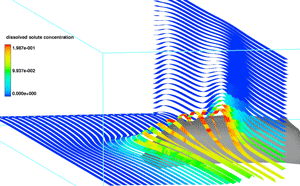 Streamlines, colored by dissolved salt concentration in flow over a solid block of salt (gray). Image courtesy of Flow Science, Inc. |
See an extended description of what's new in FLOW-3D Version 10.
Download the FLOW-3D features list.
See examples of FLOW-3D.
Request a FLOW-3D demo or User Conference Proceedings.
Watch a FLOW-3D demo online (registration required).
See the hardware and OS requirements for FLOW-3d version 10.
Read FLOW-3D case studies.
Learn about FLOW-3D/MP.
Learn about FLOW-3D FLOW-3D Cast.
Learn about FLOW-3D ThermoSET.
See why DE's Editor's selected FLOW-3D as their Pick of the Week.
Sources: Press materials received from the company and additional information gleaned from the company's website.


DE's editors contribute news and new product announcements to Digital Engineering. Press releases may be sent to them via [email protected].
Follow DE
Join over 90,000 engineering professionals who get fresh engineering news as soon as it is published.






About Us · Contact Us · Editorial Team · Advertising · Privacy Policy · Subscriber Services · © 2026 Digital Engineering 24/7 · Peerless Media