Helping design and engineering professionals discover, evaluate and specify technologies and processes that shorten the design cycle and enable success.


Alert!
Digital Engineering ceased publication on July 1, 2026. This website remains available as an archive of engineering content.
For inquiries or information, please email [email protected].

May 2026 Special Focus: Artificial Intelligence in Design and Simulation
In this Special Focus Issue, learn about the latest developments in the integration of artificial intelligence into engineering workflows.

Design & Simulation Software Guide 2025
In this Special Issue, Digital Engineering presents its second annual guide to design and simulation software vendors.
I don’t want to lead you astray with that title. Today’s Check It Out points you to a trifecta of papers for CFD (computational fluid dynamics) practitioners and engineering managers.
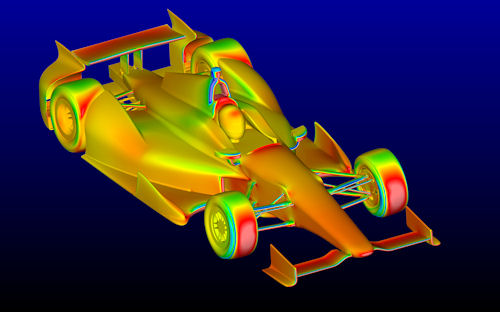 Courtesy Dallara Automobili. |
“Turbulence Modeling for Engineering Flows” is, however, a technical paper that anchors an intriguing subsection of the ANSYS website called “Fluid Dynamics Technology Tips.” Two other papers that reside on this site -- “Advanced Turbulence Modeling Methods Provide Accurate, Efficient Results in Any Fluid Flow Application” and “Best Practice: Scale-Resolving Simulations in ANSYS CFD” -- also deserve your attention. But first, let’s put the web page at the other end of today’s Check It Out link into perspective.
Something like 99% of industrial flows present turbulence issues to deal with, making turbulence modeling key to any successful CFD simulation. Problem is, turbulence is one of the most challenging phenomena to simulate. For example, it’s a multi-scale problem that can quickly tax or overwhelm even the most powerful parallel computers today. And then there are applications, say acoustics, where turbulence interacts with other physics problems, which makes everything much more complex to solve.
To cope with these inherent difficulties, technologists have devised a number of different models and modeling approaches to solve for different turbulence modeling scenarios. So, in your hands-on world, you simplify your models as much as you can then work with a set of equations that you believe offers the robustness you need to obtain accurate results. And that implies, what you’re really doing when you run a CFD code to model turbulence is that you’re leveraging an approximate formulation that should return a good, albeit approximate, solution to your inquiries.
Now, your industrial-strength CFD codes are powerful tools, but they have their job cut out for them. They have to deal with internal flows, aerodynamics, heat, mass transfer, unsteady flows, etc. And that’s OK, but, again, the complexity means that there’s no one solution out there. No one approach to modeling or model can cover all the bases, and it’s downright impractical to make a one-size-fits-all application. These are among the reasons why you need to choose the proper turbulence model and approach with the proven numerical robustness to satisfy your accuracy requirements. And which one might that be?
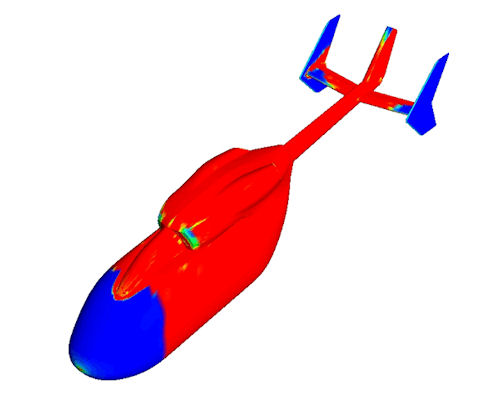 |
And that is where “Turbulence Modeling for Engineering Flows” comes in. This 25-page paper provides a rich technical overview on the industrial formulation and application of turbulence models. It’s not a comprehensive overview of turbulence modeling theory, but it is a practical tour of the major, state of the art turbulence models and modeling approaches found in industrial CFD codes. Models and approaches are explained, and pros and cons are laid out there for your consideration.
The document also casts its eye across some modeling methods that seem to hold good potential for future industrial applications. Among these are applications for modeling laminar-turbulent transition processes, addressing the challenge of computing high Reynolds number flows with wall-modeled LES (large eddy simulation), and scale-resolving simulation models in which part of the turbulence spectrum is resolved in some of the numerical domain.
As for the other two papers: “Advanced Turbulence Modeling Methods” serves as a technical summary for the anchor paper while “Best Practices” explores how you can apply the information discussed in the technical paper. In addition to these three papers, the website itself offers links to related data.
Registration is required to download these documents, but that should not deter the serious CFD maven. This is a must-have. “Turbulence Modeling for Engineering Flows” is an in-depth paper that, ahem, flows well and -- remarkably, given its weighty subject matter -- is occasionally spiced with the witty aside. Speaking of asides, here’s one: I’d be remiss not to tell you that its three pages of reference materials alone make it a mini-library of CFD theory and applications sure to interest you. Hit the link over there to access this valuable resource.
Thanks, Pal. – Lockwood
Anthony J. Lockwood
Editor at Large, Desktop Engineering


Anthony J. Lockwood is Digital Engineering's founding editor. He is now retired. Contact him via [email protected].
Follow DE






About Us · Contact Us · Editorial Team · Advertising · Privacy Policy · Subscriber Services · © 2026 Digital Engineering 24/7 · Peerless Media