Helping design and engineering professionals discover, evaluate and specify technologies and processes that shorten the design cycle and enable success.


Alert!
Digital Engineering ceased publication on July 1, 2026. This website remains available as an archive of engineering content.
For inquiries or information, please email [email protected].
Sponsored
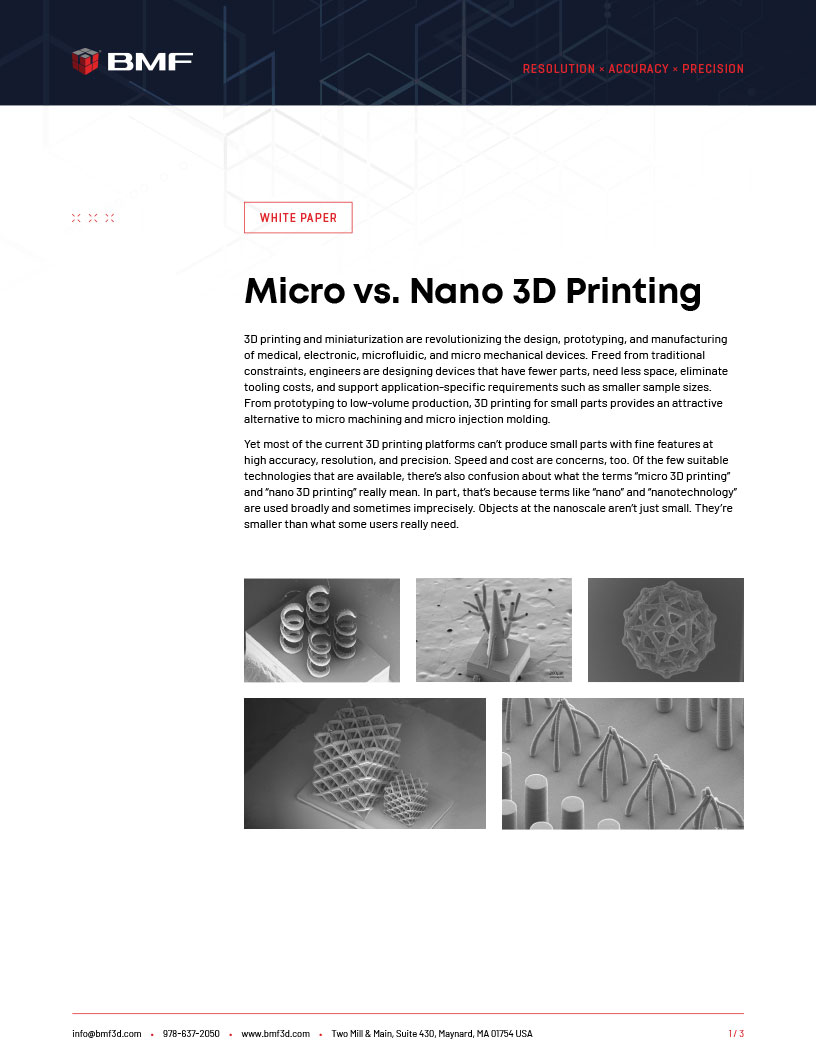
3D printing and miniaturization are revolutionizing the design, prototyping, and manufacturing of medical, electronic, microfluidic, and micro mechanical devices. Freed from traditional constraints, engineers are designing devices that have fewer parts, need less space, eliminate tooling costs, and support application-specific requirements such as smaller sample sizes.
From prototyping to low-volume production, 3D printing for small parts provides an attractive alternative to micro machining and micro injection molding. Yet most of the current 3D printing platforms can’t produce small parts with fine features at high accuracy, resolution, and precision. Speed and cost are concerns, too.
Of the few suitable technologies that are available, there’s also confusion about what the terms “micro 3D printing” and “nano 3D printing” really mean. In part, that’s because terms like “nano” and “nanotechnology” are used broadly and sometimes imprecisely. Objects at the nanoscale aren’t just small. They’re smaller than what some users really need.

Boston Micro Fabrication is the world leader in micro-precision 3D printers utilizing Projection Micro Stereolithography (PµSL) technology. Many leading companies worldwide are adopting PµSL to 3D print true microstructures with ultra-high…

Ultra-high Accuracy, Precision, and Resolution Micro 3D Printed Medical Device Manufacturing
Discover how the use of micro-precision 3D printing is aiding medical device producers to tackle two common issues through this white paper.




About Us · Contact Us · Editorial Team · Advertising · Privacy Policy · Subscriber Services · © 2026 Digital Engineering 24/7 · Peerless Media