Helping design and engineering professionals discover, evaluate and specify technologies and processes that shorten the design cycle and enable success.



Digital Engineering April 2026
In the latest issue of Digital Engineering, we take a look at the latest innovations in design for additive manufacturing, including the use of natural language inputs, social media cosplayers, and AI integration. The issue also includes a feature…

January Special Focus Issue: Design for Additive
In this Special Focus Issue of Digital Engineering, learn about the latest advancements in design for additive manufacturing, including new software tools, additive in automotive, custom medical devices, and more.
Coincidence is a funny thing. I grew up in a small housing development just off U.S. Route 30, deep in the countryside of Ohio. When I looked up directions for my visit to ExOne’s factory near Pittsburgh, PA, I was amused to find the place I was headed was also just off U.S. Route 30. Not quite down the street, but still the same road.
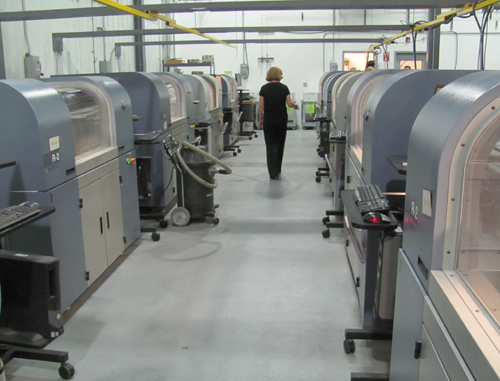
The company that would become ExOne was originally part of Extrude Hone, supplier and developer of nontraditional machining processes and automated systems. The owner of Extrude Hone and ExOne, Larry Rhoades, was interested by the possibilities offered by additive manufacturing (AM).
ExOne at a GlanceCompany: ExOne Headquarters: North Huntingdon, PA Offices: Japan, Germany and the U.S. Year Founded: 2005 Product Lines and Services: M-Lab, M-Flex, M-Print, S-Print, Orion (subtractive), ExMal materials developing consulting, global research and development, ExSource Contract service, ExParts service, ExMicro Contract service, ExTec educational services. Materials: Metals, sand and glass. Technologies: Digital Part Materialization (ASTM binder jetting) |
“He [Rhoades] was a visionary. He was always looking for other technologies that were in their infancy that he could develop and commercialize,” said Robert D. Wood, ExOne general manager. “He found out about 3D printing being developed at MIT around 1996, so we went and exclusively licensed those patents for the 3D printing of metal. We also received a non-exclusive license for the 3D printing of ceramics for foundry materials.”
Extrude Hone began research and development (R&D) of AM processes based on its license agreements. In 2005, Rhoades sold Extrude Hone to Kennametal, taking all AM processes and research with him to create ExOne. The company was mainly focused on R&D for the first year and a half of its existence. Following the sudden passing of Rhoades, the company was picked up in 2008 by Kent Rockwell of Rockwell Venture Capital, Inc.
Under Rockwell, the company refocused on commercialization of its processes to operate as an independent financial entity. It began to operate as a service bureau, developed its line of AM systems and concentrated on finding customers that could benefit from the products and services it offered.
Additive Manufacturing Systems
Today, ExOne offers five different AM systems. The technologies can be divided into the M (metal) and S (sand casting) lines. ExOne refers to its process as “Digital Part Materialization” (or what the ASTM might call binder jetting). According to the company, ExOne offers the largest 3D printers on the planet in both lines.
“For our machines, the focus when they were designed was to provide better economics,” said Wood. “In this business, better economics is speed and volume.”
The ExOne process varies slightly depending on which material is being used, but, in general, powdered material is treated with a bonding agent from a print head to create an object. Just like with other 3D printing, the object is built up a slice at a time until complete. Sand objects come directly out of the build box, and loose sand is removed to reveal a mold or core for casting.
Metal objects are taken from the build box and excess material is removed using an alcohol-based cleaner. The object is then placed into a furnace for sintering, which burns out the binder and fuses the metal molecules into a solid part. The process can leave small internal gaps, which are filled using infiltration (generally a bronze infiltrant) and a second thermal process, resulting in a fully dense object.
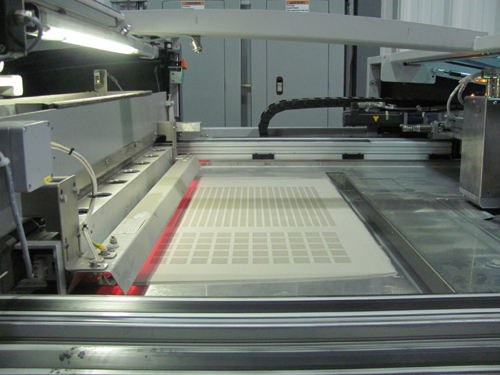
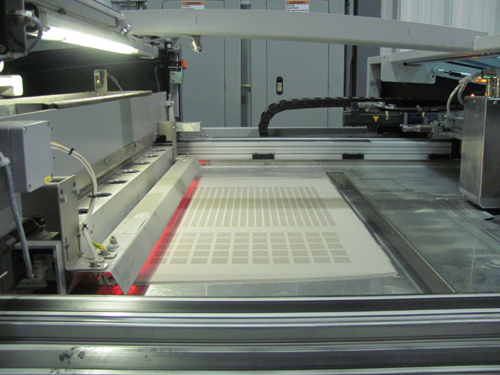
The M-Lab was designed for customers in the fields of research and education, with a build envelope of 1.5 x 2.3 x 1.3 in. (40 x 60 x 35 mm) and a build speed of 1 minute/.05 mm layer. This compact system requires no support structure and materials usage includes 420 and 316 stainless steel, bronze, tungsten and glass.
The M-Flex offers a build envelope of 15.7 x 9.8 x 9.8 in. (400 x 250 x 250 mm) with a build speed of 30 seconds/.100 mm layer. The largest metal printer offered by ExOne is the M-Print, with a build envelope of 30.7 x 15.75 x 15.75 in. (780 x 400 x 400 mm) and a build speed of 40 seconds/layer. Layer thickness varies from between .28 to .50 mm. Both printers can build using a number of materials including 420 and 316 stainless steel, bronze, tungsten, Soda lime (semi-opaque) glass and sand.
For the sand casting line, the S-Print has a build envelope of 29.5 x 15 x 15 in. (750 x 380 x 400 mm), with a build speed of 40 seconds/layer. The S-Max offers a build envelope of 70.9 x 39.37 x 27.56 in. (1800 x 1000 x 700 mm), with a build speed of between 59,400 to 108,000 cm3/hour. Layer thickness for both machines varies from between .28 to .50 mm.
Unsurprisingly, the material used for these systems is sand, along with a specially formulated ExOne binder and activator.
An Interesting Case Study
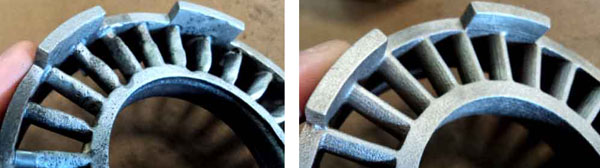
ExOne still acts as a service bureau for customers that would like to benefit from AM without having to invest in purchasing a system. Ulterra, for instance, contacted ExOne to design and build a stator for use in gas and oil drilling. Working with the client, ExOne created a stator using a S4 stainless steel/bronze matrix to replace the standard 4145 steel part.
Standard life expectancy for a stator down in the environment of abrasive slurry that is a byproduct of drilling is 200-300 hours. The ExOne created stator lasted for 600 hours with no appreciable wear. ExOne says the reason for this can be found in its AM process.
“It seems like any job that’s dealing with some kind of abrasive slurry, our materials do quite well in,” said Wood. “I think what’s happening is that on the surface of our material we have all these stainless steel particles that are sintered together, but any porosity is filled with bronze. As that part starts to wear the first thing that’s going to get worn off is the softest material, which is the bronze. And then you have the abrasives in the slurry getting stuck in that surface porosity and fusing to the part.”
Not only do these parts last longer, they are also less expensive to produce. Using traditional manufacturing methods, a stator costs $400-$500, while the same part created using AM costs only $75-$150.
Below you’ll find a video overview of ExOne.
Sources: Interview with the company, press materials received from the company and additional information gleaned from the company’s website.


John Newman is a Digital Engineering contributor who focuses on 3D printing. Contact him via [email protected] and read his posts on Rapid Ready Technology.
Follow DE
Join over 90,000 engineering professionals who get fresh engineering news as soon as it is published.






About Us · Contact Us · Editorial Team · Advertising · Privacy Policy · Subscriber Services · © 2026 Digital Engineering 24/7 · Peerless Media