Helping design and engineering professionals discover, evaluate and specify technologies and processes that shorten the design cycle and enable success.



Digital Engineering April 2026
In the latest issue of Digital Engineering, we take a look at the latest innovations in design for additive manufacturing, including the use of natural language inputs, social media cosplayers, and AI integration. The issue also includes a feature…

January Special Focus Issue: Design for Additive
In this Special Focus Issue of Digital Engineering, learn about the latest advancements in design for additive manufacturing, including new software tools, additive in automotive, custom medical devices, and more.
Those statements are obviously opinion and aren’t entirely accurate. AM is already being used to create vehicle parts and speeds up the development cycle for more traditionally machined parts. The technology has been embraced by aerospace and defense for its adaptability. So while it’s true AM isn’t printing whole cars, what if it could?
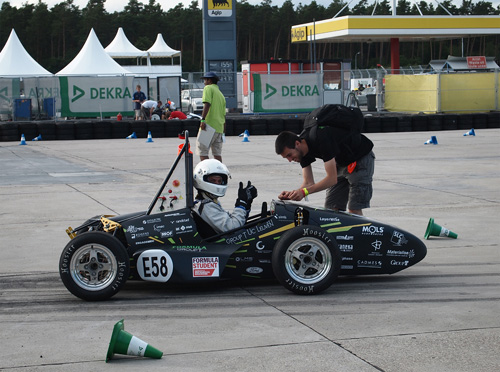
Formula Group T is a group of 16 masters students in engineering from GROUP T - International University College Leuven near Brussels, Belgium. The group designs and builds small electric race cars to compete with other universities from around the world in the Formula Student competition. The car they designed for the 2012 competition is named the Aerion.
Rather than construct their vehicle the old-fashioned way, Formula Group T contacted Materialise to print out the body of the car using the company’s Mammoth stereolithography machine. The Mammoth printer has a build area of 2100 x 700 x 800 mm. With it, they were able to plan and print out the entirety of the body in a single week.
Formula Group T also took the opportunity to design some integrated features into the body to be created during the print. The nose of the Aerion was given a shark skin texture, like that on world-class swimming suits. The idea was to improve performance, allowing the car to cut through the air like a shark cuts through water.
Left and right side cooling pods were 3D printed as well. The left side included a nozzle behind the radiator and a diffuser to optimize air flow, while the right side was built with a complex internal geometry to create a “cyclone effect” that ensures any intake of water are filtered away from air intake before it reaches the engine.
While it would be a fib to say the entire car was printed out using AM, the technology certainly played an important role in the creation of the vehicle. A number of companies are investigating the possibilities of using massive 3D printers for similar end-use products. It might not be too long before you see a Honda logo on a 3D printed body.
Below you’ll find a short video featuring the Aerion.
Sources: Materialise, Formula T Group


John Newman is a Digital Engineering contributor who focuses on 3D printing. Contact him via [email protected] and read his posts on Rapid Ready Technology.
Follow DE
Join over 90,000 engineering professionals who get fresh engineering news as soon as it is published.






About Us · Contact Us · Editorial Team · Advertising · Privacy Policy · Subscriber Services · © 2026 Digital Engineering 24/7 · Peerless Media