Helping design and engineering professionals discover, evaluate and specify technologies and processes that shorten the design cycle and enable success.



May 2026 Special Focus: Artificial Intelligence in Design and Simulation
In this Special Focus Issue, learn about the latest developments in the integration of artificial intelligence into engineering workflows.

April 2026 Special Focus Issue: Generative Design
In this Special Focus Issue, Digital Engineering takes a look at how generative design solutions can be used across different types of design problems and with a variety of manufacturing approaches to accelerate design space exploration, and…
Microsoft Research is just as interested in the IoT as other tech companies, and has been quietly working away on ways to include the technology in a number of objects via a variety of different sensor types. Most of this research uses RFID chips for tracking purposes, but new research has developed a method of using terahertz (THz) imaging to read specially designed structures within objects built with additive manufacturing (AM).
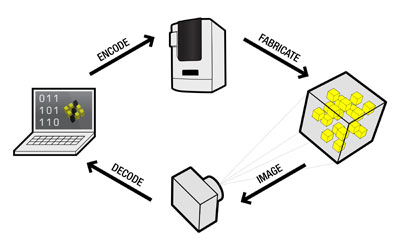
The system is called InfraStructs, and is the brainchild of Karl Willis, from Carnegie Mellon University, and Andrew Wilson, from Microsoft. The basic premise of InfraStructs is to use the capability of AM to build complex internal geometries to self-embed three dimensional codes into objects that have been wholly or partially built using a 3D printer. These codes are then read by a THz scanning device and used for everything from simple identification to actual programming code that allows objects to connect with outside systems.
“It has to do with the waveforms you get when the scan penetrates the object,” Wilson explains. “We are able to distinguish between transitions in the material, void or non-void, by measuring the reflection distance. We investigated a lot of the really early depth-camera technologies, and at some level, it’s all consistent with that line of research.”
The researchers foresee a day when InfraStructs could also be used to generate entire interactive environments for robots. Small InfraStructs codes would, fairly cheaply, allow a robot to determine what was around it and decide how to interact with its environment to complete tasks. THz technology is a bit behind other sensor research, but interest drives research, and if InfraStructs works as well as Wilson and Willis expect, it could quickly gain ground.
You can read about the research here (.pdf) and below you’ll find a video that discuss the InfraStructs system.
Source: Microsoft Research


John Newman is a Digital Engineering contributor who focuses on 3D printing. Contact him via [email protected] and read his posts on Rapid Ready Technology.
Follow DE
Join over 90,000 engineering professionals who get fresh engineering news as soon as it is published.






About Us · Contact Us · Editorial Team · Advertising · Privacy Policy · Subscriber Services · © 2026 Digital Engineering 24/7 · Peerless Media