Helping design and engineering professionals discover, evaluate and specify technologies and processes that shorten the design cycle and enable success.



Digital Engineering April 2026
In the latest issue of Digital Engineering, we take a look at the latest innovations in design for additive manufacturing, including the use of natural language inputs, social media cosplayers, and AI integration. The issue also includes a feature…

January Special Focus Issue: Design for Additive
In this Special Focus Issue of Digital Engineering, learn about the latest advancements in design for additive manufacturing, including new software tools, additive in automotive, custom medical devices, and more.
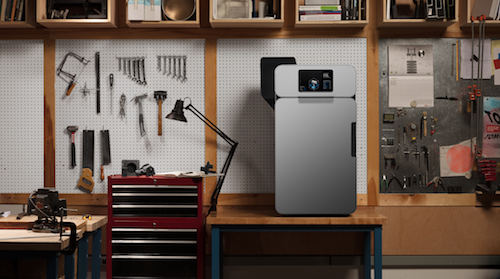
Formlabs, founded in 2011 by a group hailing from the MIT Media Lab, this week announced the Fuse 1, a new model that brings previously expensive and complex selective laser sintering (SLS) technology to a benchtop model, and Form Cell, an automated product solution for additive manufacturing built around the company’s existing Form 2 stereolithography printer.
The company, now 270 people (including 100 engineers) with offices in Cambridge, MA, and Berlin, sees its mission as making 3D printing as simple as 2D printing. “We aim to take technology that’s not that accessible and make it accessible,” says David Lakatos, Formlabs’ chief product officer. “We’re aiming to radically reduce the price of technology without compromising quality.”
 Formlabs Fuse 1 brings the industrial power of SLS printing to the benchtop. Image Courtesy of Formlabs
While Formlabs Form 2 and other SLA printers support the quality and surface finishes to handle prototyping applications, the technology is not optimal for producing production parts because the thermal plastic material gets brittle over time, Lakatos explains. SLS technology, which is employed by 3D printing service bureaus, is well-suited to production part applications, but systems are very sophisticated and expensive (priced upwards of several hundred thousand dollars), which dramatically limits use cases.
“The engineering community at large only has had access to this technology through service bureaus—it has not been part of everyday product design and production,”Lakatos says.
Formlabs is aiming to change that equation with the new Fuse 1 line, which leverages the proprietary optical system used in the Form 2 along with temperature control technologies, and the company's materials expertise. The Fuse 1, slated for shipment mid-2018, leverages nylon PA 12 and PA 11 materials, which means parts produced meet or exceed the materials properties published by SLS counterparts, Formlabs officials say. SLS technology in general accounts for the least expensive per-part costs in 3D printing. The printer starts at $9,999, but the complete package (including a post-processing station, among other capabilities) is $19,999, far below the price tag of comparable SLS printers.
Along with the Fuse 1, Formlabs rolled out another solution aimed at boosting 3D printing’s role in digital manufacturing by specifically bringing down the cost per part, noted Max Lobovsky, Formlabs co-founder, in a formal presentation announcing the new product portfolio. “The best cost per part with 3D printing has limited its applications today,” Lobovsky says. “If we can bring that cost down, we can open up the benefits of 3D printing.”
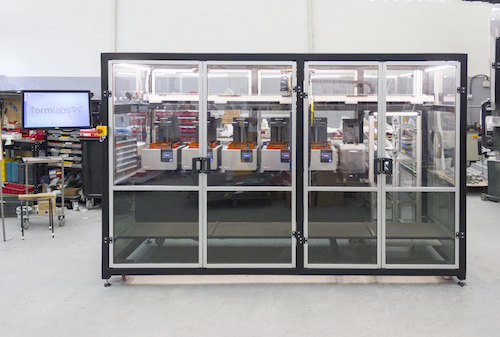 Form Cell aims to automate manual 3D printing tasks to achieve the lowest cost per part. Image Courtesy of Formlabs
To do that, Formlabs showcased the Form Cell, a prototype of an automated production solution that combines multiple Form 2 units, a robotic arm, and software for driving autonomous operation by parallelizing repetitive 3D printing processes. In the prototype showcased, an industrial gantry system automatically moved finished parts from the printer to a curing station, eliminating much of the manual labor associated with 3D printing and in turn, helping to reduce the cost per part. Moreover, the Form Cell, which will be configured based on individual companies’ needs, is designed for continuous operation, pushing 3D printing closer to the goal of a lights-out, 24X7 operation, officials say.
In related news, Formlabs also announced a partnership with footwear manufacturer New Balance. The pair are working on bringing large-scale 3D printing to New Balance by collaborating on footwear-specific materials and printers (based on the Form 2) that will help improve athlete performance. Continuous production based on the new technology is slated to kick off in New Balance manufacturing plants starting in 2018.
Check out this video to see the Fuse 1 in action.


Beth Stackpole is a contributing editor to Digital Engineering. Send e-mail about this article to [email protected].
Follow DE
Join over 90,000 engineering professionals who get fresh engineering news as soon as it is published.






About Us · Contact Us · Editorial Team · Advertising · Privacy Policy · Subscriber Services · © 2026 Digital Engineering 24/7 · Peerless Media