Helping design and engineering professionals discover, evaluate and specify technologies and processes that shorten the design cycle and enable success.



Digital Engineering April 2026
In the latest issue of Digital Engineering, we take a look at the latest innovations in design for additive manufacturing, including the use of natural language inputs, social media cosplayers, and AI integration. The issue also includes a feature…

January Special Focus Issue: Design for Additive
In this Special Focus Issue of Digital Engineering, learn about the latest advancements in design for additive manufacturing, including new software tools, additive in automotive, custom medical devices, and more.
In some cases, 3D printing developments have helped improve existing materials. We reported a few weeks ago on research that will not only make it possible to print with high-strength aluminum, but that could actually allow the previously unweldable material to be welded.
Now, scientists at Lawrence Livermore National Laboratory in California have developed a way to 3D print with stainless steel that results in materials that are up to three times stronger than steels created using traditional techniques.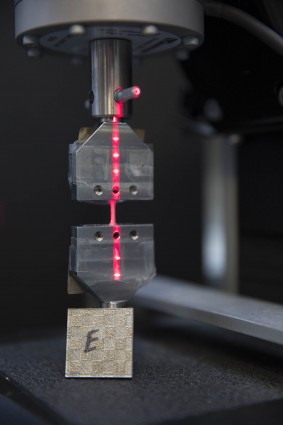
"In order to make all the components you're trying to print useful, you need to have this material property at least the same as those made by traditional metallurgy," said LLNL materials scientist and lead author Morris Wang. "We were able to 3D print real components in the lab with 316L stainless steel, and the material's performance was actually better than those made with the traditional approach. That's really a big jump. It makes additive manufacturing very attractive and fills a major gap."
Stainless steel is a popular material for manufacturing across many different industries. Creating a printable version of the alloy has proven difficult, however, because the final material is so porous that it is much weaker and likely to fracture.
Lawrence Livermore had previously developed a process that combined lasers and rapid cooling to fuse metal alloy particles densely together. A computer-driven version of that process allows them to control the material from the nanoscale to micron scale, including structures in the steel that can prevent fractures. The team was able to print a low-carbon steel called 316L.
Tests have shown that under some conditions the material is three-times stronger than conventionally made steel.
"This microstructure we developed breaks the traditional strength-ductility tradeoff barrier," Wang said. "For steel, you want to make it stronger, but you lose ductility essentially; you can't have both. But with 3D printing, we're able to move this boundary beyond the current tradeoff."
The next phase of research will involve more simulation and applying these techniques to other alloys. According to Lawrence Livermore:
The eventual goal … is to use high-performance computing to validate and predict future performance of stainless steel, using models to control the underlying microstructure and discover how to make high-performance steels, including the corrosion-resistance. Researchers will then look at employing a similar strategy with other lighter weight alloys that are more brittle and prone to cracking.
The Lawrence Livermore team worked with engineers from Ames National Laboratory, Georgia Tech, and Oregon State. You can read more about this work in the journal Nature Materials.
Source: Science


Brian Albright is the editorial director of Digital Engineering.
Contact him at [email protected].

Join over 90,000 engineering professionals who get fresh engineering news as soon as it is published.






About Us · Contact Us · Editorial Team · Advertising · Privacy Policy · Subscriber Services · © 2026 Digital Engineering 24/7 · Peerless Media