Helping design and engineering professionals discover, evaluate and specify technologies and processes that shorten the design cycle and enable success.


Alert!
Digital Engineering ceased publication on July 1, 2026. This website remains available as an archive of engineering content.
For inquiries or information, please email [email protected].

Cut Retrieval-Augmented Generation (RAG) Hallucinations by 50%
Most teams hit the same wall with enterprise AI: LLMs that hallucinate, pipelines that don’t scale, and infrastructure that’s harder to design than the models themselves.

What Is Intelligent BOM Management? A Guide to Smarter Product Development
Learn how intelligent Bill of Materials (BOM) management helps teams collaborate, reduce errors, and bring innovative products to market faster with cloud-based PLM tools.
AMD has joined Lawrence Livermore National Laboratory (LLNL) and HPE, in announcing that El Capitan, the upcoming exascale class supercomputer at LLNL, will be powered by next-generation AMD EPYC CPUs, AMD Radeon Instinct graphics processing units and open-source AMD ROCm heterogeneous computing software.
With delivery expected in early 2023, the El Capitan system is expected to be an exceptionally fast supercomputer with more than 2 exaflops of double precision performance. This performance will support National Nuclear Security Administration (NNSA) requirements for its primary mission of ensuring the safety, security and reliability of the nation’s nuclear stockpile.
The AMD-based nodes will be optimized to accelerate artificial intelligence (AI) and machine learning (ML) workloads to potentially enable the expanded use of AI and ML into the research, computational techniques and analysis that benefits NNSA missions.
“El Capitan will drive unprecedented advancements in HPC and AI, powered by the next generation AMD EPYC CPUs and Radeon Instinct GPUs,” says Forrest Norrod, senior vice president and general manager, Datacenter and Embedded Systems Group, AMD. “Building on our strong foundation in high-performance computing and adding transformative coherency capabilities, AMD is enabling the NNSA Tri-Lab community—LLNL and the Los Alamos and Sandia national laboratories—to achieve their mission critical objectives and contribute new AI advancements to the industry.”
AMD is applying its experience from the high-performance computing industry and advancing its existing CPU and GPU designs for El Capitan, enabling the system to be architected for maximum performance and ease of use.
AMD technology within El Capitan includes:
“This unprecedented computing capability, powered by advanced CPU and GPU technology from AMD, will sustain America’s position on the global stage in high-performance computing and provide an observable example of the commitment of the country to maintaining an unparalleled nuclear deterrent,” says LLNL Lab Director Bill Goldstein.
“We are pleased to partner with AMD to bring together HPE’s Cray Shasta architecture with latest AMD EPYC CPUs and Radeon Instinct GPUs and provide leadership technology in support of the mission critical HPC and AI workloads for Lawrence Livermore National Laboratory,” says Peter Ungaro, senior vice president and general manager, HPC and Mission Critical Solutions (MCS) at HPE.
“In our three U.S. exascale wins this last year, which includes the U.S. Department of Energy’s Frontier at Oak Ridge National Laboratory, the HPE systems and technologies along with AMD processors and GPUs have become a unique solution for high-performance and exascale-class computing and we look forward to continuing our collaboration to further bolster innovation,” Ungaro says.
Sources: Press materials received from the company and additional information gleaned from the company’s website.


AMD, or Advanced Micro Devices, has driven innovation in high-performance computing, graphics and visualization technologies. They develop high-performance computing and visualization products to solve some of the world’s toughest and most…
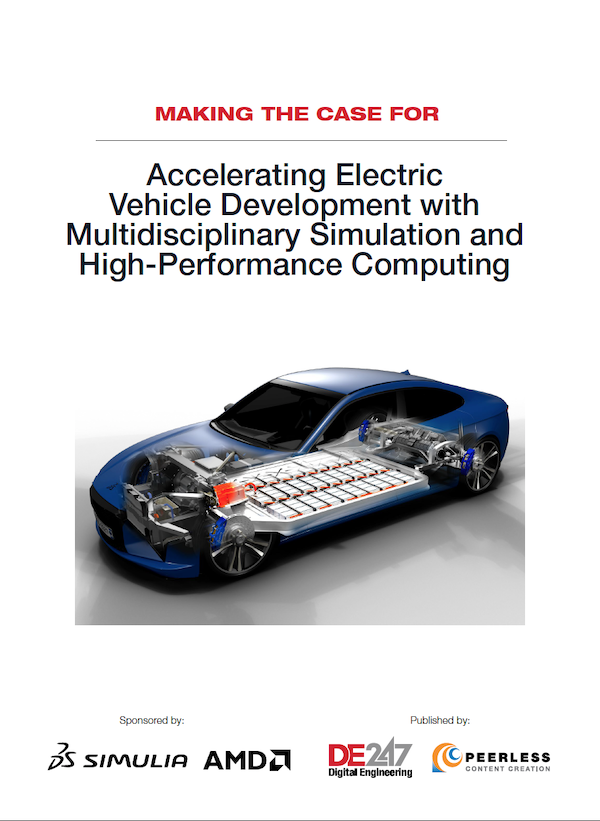
Accelerating Electric Vehicle Development with Multidisciplinary Simulation and High-Performance Computing
In this new Making the Case guide, learn how a unified approach to design and multidisciplinary simulation from Dassault Systèmes, combined with high-performance computing powered by AMD EPYC™ processors, can accelerate EV design.

DE's editors contribute news and new product announcements to Digital Engineering. Press releases may be sent to them via [email protected].
Follow DE






About Us · Contact Us · Editorial Team · Advertising · Privacy Policy · Subscriber Services · © 2026 Digital Engineering 24/7 · Peerless Media