Helping design and engineering professionals discover, evaluate and specify technologies and processes that shorten the design cycle and enable success.


Alert!
Digital Engineering ceased publication on July 1, 2026. This website remains available as an archive of engineering content.
For inquiries or information, please email [email protected].

Digital Engineering April 2026
In the latest issue of Digital Engineering, we take a look at the latest innovations in design for additive manufacturing, including the use of natural language inputs, social media cosplayers, and AI integration. The issue also includes a feature…

January Special Focus Issue: Design for Additive
In this Special Focus Issue of Digital Engineering, learn about the latest advancements in design for additive manufacturing, including new software tools, additive in automotive, custom medical devices, and more.
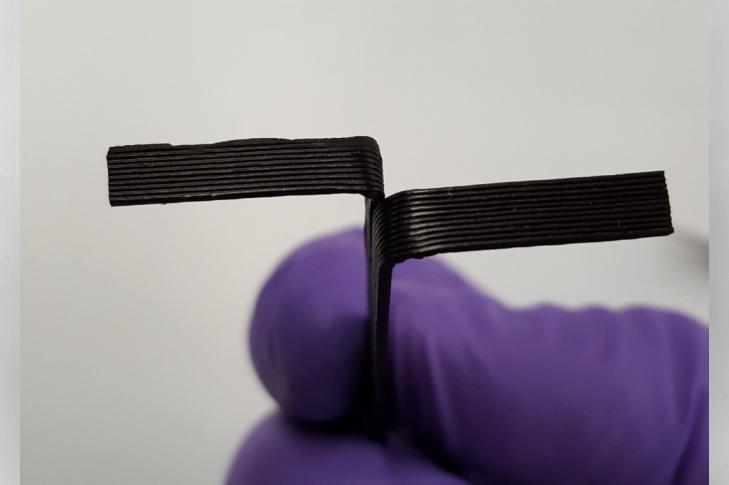
There have been great strides made in developing new 3D printing materials, everything from new plastics, metals, food, and even human cells. Researchers at Oak Ridge National Laboratory (ORNL) are further expanding the 3D print palette with plant-based materials.
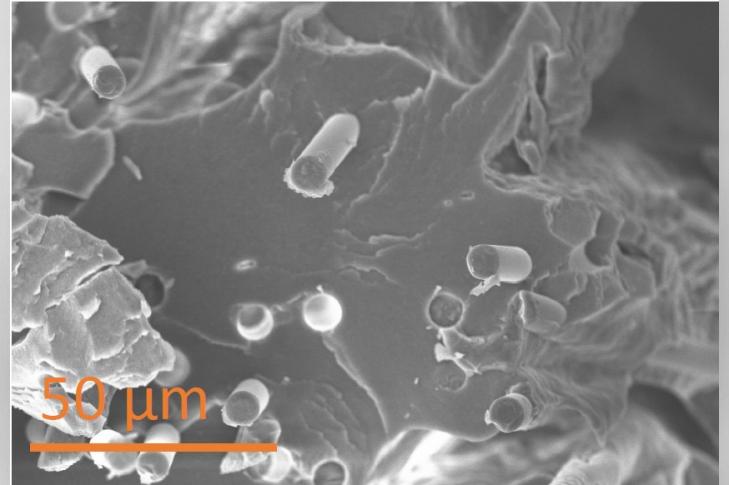 A cross-section of the weld area between two 3D-printed layers of a plant-based composite material developed by ORNL. Image: Christopher Bowland/Oak Ridge National Laboratory, U.S. Dept. of Energy.
The scientists are using lignin, a byproduct of the biofuel manufacturing process, which is combined with rubber, carbon fiber and ABS to create structures that have “100 percent improved weld strength between layers over ABS alone,” according to Oak Ridge.
According to ORNL, this is a potential new use for the waste stream from biorefineries. The lignin has a low melt viscosity, which facilitates melt flow, as well as thermal crosslinking for the lignin and rubber phases of the material. The carbon fiber improves material performance and lowers the degree of chemical crosslinking formed in the matrix during the melt-phase synthesis, and working with ABS improves the bonding of the structure.
Lignin is a polymer found in most terrestrial plants. While it can be burned to generate power in industrial-scale biorefineries, modern facilities generate more lignin than can be used for power operation.
According to ORNL, the researchers there will continue to test and improve the lignin-based print materials they have developed.
“To achieve this, we are building on our experience with lignin during the last five years,” said ORNL’s Amit Naskar. “We will continue fine tuning the material’s composition to make it even stronger.”
The team published the research in Applied Materials Today.
Source: Oak Ridge National Laboratory


Brian Albright is the editorial director of Digital Engineering.
Contact him at [email protected].






About Us · Contact Us · Editorial Team · Advertising · Privacy Policy · Subscriber Services · © 2026 Digital Engineering 24/7 · Peerless Media