Helping design and engineering professionals discover, evaluate and specify technologies and processes that shorten the design cycle and enable success.


Alert!
Digital Engineering ceased publication on July 1, 2026. This website remains available as an archive of engineering content.
For inquiries or information, please email [email protected].

Digital Engineering April 2026
In the latest issue of Digital Engineering, we take a look at the latest innovations in design for additive manufacturing, including the use of natural language inputs, social media cosplayers, and AI integration. The issue also includes a feature…

January Special Focus Issue: Design for Additive
In this Special Focus Issue of Digital Engineering, learn about the latest advancements in design for additive manufacturing, including new software tools, additive in automotive, custom medical devices, and more.
Multimaterial printing could potentially increase the utility of additive manufacturing by allowing companies to create a single part with different physical properties – replacing more complex assemblies. However, using multiple materials can be extremely challenging, given the different melt points and other properties. Adhesive points between the two different materials can also create performance problems.
Researchers at Washington State University may have discovered a solution – a one-step printing process that uses two different materials in a single 3D printer.
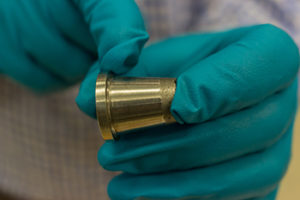
The team was led by Amit Bandyopadhyay, Herman and Brita Lindholm Endowed Chair Professor in the School of Mechanical and Materials Engineering. The researchers used 3D printing technology to print metal and ceramic structures along with a bimetallic tube that is magnetic in one end and nonmagnetic in the other.
The process used a laser-based 3D printer to join nickel-chromium and copper in a single step.
According to an article published by the University:
“Inconel 718 is a nickel-chromium alloy used in liquid-fueled rockets and for sheet metal parts for airplane engines. The material is able to withstand high temperatures well, but it cools very slowly. When the researchers added the copper in the 3D printing process, the part could be cooled 250 percent faster, meaning a longer life and higher fuel efficiency for airplane engines.”
The team published their work in Additive Manufacturing this year.
“This is a step towards the next level of manufacturing and the next generation of design, validation, optimization and manufacturing using 3D printing,” said Bandyopadhyay.
The process could also potentially eliminate the need for adhesives or joint connections in multimaterial products.
“You could be joining two very strong materials together, but their connection will only be as strong as their adhesive,” said Bandyopadhyay. “Multimaterial, additive manufacturing helps get rid of the weak point.”
Source: Washington State University


Brian Albright is the editorial director of Digital Engineering.
Contact him at [email protected].






About Us · Contact Us · Editorial Team · Advertising · Privacy Policy · Subscriber Services · © 2026 Digital Engineering 24/7 · Peerless Media