Helping design and engineering professionals discover, evaluate and specify technologies and processes that shorten the design cycle and enable success.


Alert!
Digital Engineering ceased publication on July 1, 2026. This website remains available as an archive of engineering content.
For inquiries or information, please email [email protected].

Digital Engineering April 2026
In the latest issue of Digital Engineering, we take a look at the latest innovations in design for additive manufacturing, including the use of natural language inputs, social media cosplayers, and AI integration. The issue also includes a feature…

January Special Focus Issue: Design for Additive
In this Special Focus Issue of Digital Engineering, learn about the latest advancements in design for additive manufacturing, including new software tools, additive in automotive, custom medical devices, and more.
One of the biggest winners from this new brand of manufacturing is the construction of prosthetics. Additive manufacturing (AM) not only makes building prosthetics far less expensive than older techniques, but also allows the devices to be put together wherever AM can be set up. Charitable organizations have taken this opportunity to begin setting up 3D printing workshops in rural Africa.
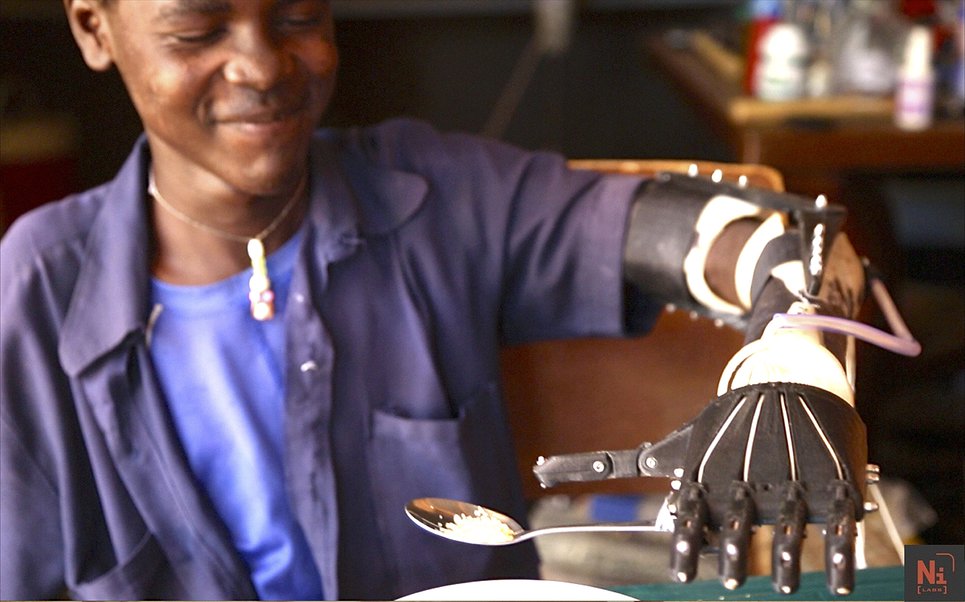
Not Impossible Labs (NiL) and Project Daniel were founded by Mick Ebeling and Elliot Kotek after hearing about a Sudanese boy named Daniel that lost both his arms to bombs. Daniel was unable to feed himself, and felt like a burden to his family until NiL visited him at his home and helped set up a digital manufacturing lab.
Using 3D scanning, Daniel’s measurements were taken and a low-cost arm and hand prosthetic design was altered to fit. The prosthetic was then printed out and assembled at the South Sudan site. Since assembling a new arm for Daniel, other Sudanese amputees have come to the manufacturing lab looking for help. So far, the lab has created arms for four other patients at a cost of around $100 for each prosthetic.
The University of Toronto (U of T) has also reached out to people in need of prosthetics in Uganda. Partnering with an NGO and Ugandan hospital, U of T has set up a system whereby 3D scans of patients are digitally sent to the university, and fully developed prosthetic designs are returned. This process helps patients in areas of Uganda where prosthetic technicians are in short supply.
“The major issue with prosthetics in the developing world is not access to the materials of prosthetics; it is access to the expert knowledge required to form and create them,” says Matt Ratto, a professor in the Faculty of Information. “We’re lacking prosthetic technicians, not prosthetics themselves.”
Below you’ll find a video about Project Daniel.
Sources: Not Impossible Labs, University of Toronto


John Newman is a Digital Engineering contributor who focuses on 3D printing. Contact him via [email protected] and read his posts on Rapid Ready Technology.
Follow DE
Join over 90,000 engineering professionals who get fresh engineering news as soon as it is published.






About Us · Contact Us · Editorial Team · Advertising · Privacy Policy · Subscriber Services · © 2026 Digital Engineering 24/7 · Peerless Media