Helping design and engineering professionals discover, evaluate and specify technologies and processes that shorten the design cycle and enable success.


Alert!
Digital Engineering ceased publication on July 1, 2026. This website remains available as an archive of engineering content.
For inquiries or information, please email [email protected].
Sponsored

May 2026 Special Focus: Artificial Intelligence in Design and Simulation
In this Special Focus Issue, learn about the latest developments in the integration of artificial intelligence into engineering workflows.

Design & Simulation Software Guide 2025
In this Special Issue, Digital Engineering presents its second annual guide to design and simulation software vendors.

 Dear DE Reader:
In the extreme brevity arena, the feds and computerdom reign acronym champs, but additive manufacturing (AM) is a contender. If you dread the upcoming YAM (yet another meeting) to match 3D printing options with what your outfit does and know that people will stumble in the fog of AM acronyms, MMW: you will be glad to have today's Check it Out materials to pass around.
On two levels and in a splendidly lean manner, Markforged does yeoman's work in its “3D Printing Buyers Guide” white paper. First, it's brief — just seven pages. Second, it's digestible: It's remarkably devoid of the aggravations inherent in explaining too little or too much. Like Baby Bear's porridge, it's just right.
After a short intro, this paper hits you with an infographic of common AM technologies. It looks something like an ancestry chart. The top line lists four material families — thermoplastics, composites, photopolymers and metals. From these flow branches down into the acronyms representative of the technologies that work with the materials. Yes, the acronyms are spelled out. Most are then self-explanatory.
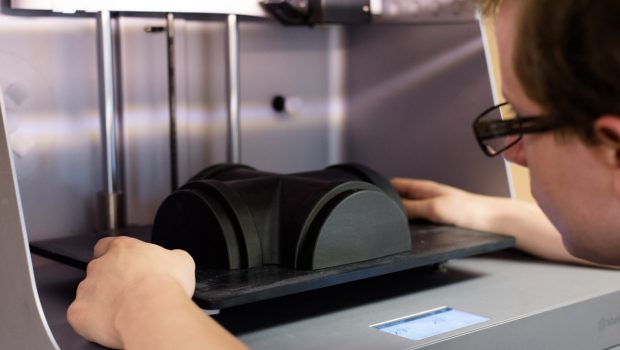 The “3D Printing Buyers Guide” from Markforged offers a clear, uncluttered rundown of additive manufacturing machines and materials that can help you identify the optimal solution for your workflow and maximize your return on investment. Image courtesy of Markforged Inc.
But what's next is equally as clear and more generally valuable. See, the paper then looks at the materials individually and then how they work with additive processes. The formula for these discussions applies for all four materials. We'll use thermoplastics as the example.
The thermoplastics treatment begins with a thumbnail sketch of the typical usage for the material and the part performance characteristics you can expect. The paper outlines two processes associated with thermoplastic fabrication separately, so there's no conflating one with the other. A simple sidebar accompanying each process ticks off the pros and cons of its operation as well as the parts it fabricates.
That's the formula. It works like a charm. If someone at your YAM can't follow this paper, they need a new career.
Now, return on investment is always some grump's default position at a new technology investment YAM. To that end, the paper wraps up with a live-linked invitation to try Markforged's ROI calculator. It's geared toward their hardware and material offerings, of course. But it provides some eye-opening results, and it's fun to use.
Horace wrote in “Ars Poética” that “whatever advice you give, be brief.” Markforged took that counsel to heart in its “3D Printing Buyers Guide” white paper. The result is an eminently helpful resource. Hit today's Check it Out link to download your copy.
Thanks, Pal. – Lockwood
Anthony J. Lockwood
Editor at Large, DE


Anthony J. Lockwood is Digital Engineering's founding editor. He is now retired. Contact him via [email protected].
Follow DE






About Us · Contact Us · Editorial Team · Advertising · Privacy Policy · Subscriber Services · © 2026 Digital Engineering 24/7 · Peerless Media