Helping design and engineering professionals discover, evaluate and specify technologies and processes that shorten the design cycle and enable success.


Alert!
Digital Engineering ceased publication on July 1, 2026. This website remains available as an archive of engineering content.
For inquiries or information, please email [email protected].

Digital Engineering April 2026
In the latest issue of Digital Engineering, we take a look at the latest innovations in design for additive manufacturing, including the use of natural language inputs, social media cosplayers, and AI integration. The issue also includes a feature…

January Special Focus Issue: Design for Additive
In this Special Focus Issue of Digital Engineering, learn about the latest advancements in design for additive manufacturing, including new software tools, additive in automotive, custom medical devices, and more.
Researchers at Cambridge Neuroscience have developed a new use for AM with the first experiments in printing viable retina cells. Ganglion cells and glial cells could be used to build retinal grafts, which could assist in the treatment of a number of diseases affecting the retina, or even completely repair damage . The results have been published in Biofabrication under the title “Adult rat retinal ganglion cells and glia can be printed by piezoelectric inkjet printing.”
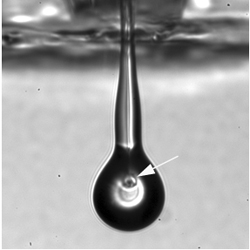
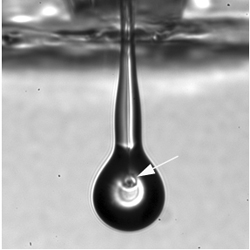
“The loss of nerve cells in the retina is a feature of many blinding eye diseases. The retina is an exquisitely organised structure where the precise arrangement of cells in relation to one another is critical for effective visual function,” said Keith Martin and Barbara Lorber, co-authors of the study. “Our study has shown, for the first time, that cells derived from the mature central nervous system, the eye, can be printed using a piezoelectric inkjet printer.”
The potential breakthrough has come as the result of developed methods which allow researchers to arrange cells into highly structured patterns and structures, through the use of AM procedures. Using a piezoelectric inkjet printer, the Cambridge team pushed cells through a sub-millimeter diameter nozzle following the directions of electrical pulses.
Unlike printing in plastic or ink, the viscosity and surface tension of the cell-laced printing material must remain within a set range of values to be successful. Once the scientists managed to find the range and print viable cells, the experiment was repeated to determine how many of the cells survived the procedure. Researchers found enough cells survived to grow in a prepared culture, which could provide the foundation for retinal grafts.
While the news is exciting, Martin and Lorber warn there’s still much work to be done before the procedure is even ready to be tested on animals, let alone human subjects. The research team also plans to expand its work.
“We plan to extend this study to print other cells of the retina and to investigate if light-sensitive photoreceptors can be successfully printed using inkjet technology,” added Martin. “In addition, we would like to further develop our printing process to be suitable for commercial, multi-nozzle print heads.”
Below you’ll find a short video about inkjet AM.
Source: University of Cambridge


John Newman is a Digital Engineering contributor who focuses on 3D printing. Contact him via [email protected] and read his posts on Rapid Ready Technology.
Follow DE
Join over 90,000 engineering professionals who get fresh engineering news as soon as it is published.






About Us · Contact Us · Editorial Team · Advertising · Privacy Policy · Subscriber Services · © 2026 Digital Engineering 24/7 · Peerless Media