Helping design and engineering professionals discover, evaluate and specify technologies and processes that shorten the design cycle and enable success.


Alert!
Digital Engineering ceased publication on July 1, 2026. This website remains available as an archive of engineering content.
For inquiries or information, please email [email protected].


Digital Engineering April 2026
In the latest issue of Digital Engineering, we take a look at the latest innovations in design for additive manufacturing, including the use of natural language inputs, social media cosplayers, and AI integration. The issue also includes a feature…

January Special Focus Issue: Design for Additive
In this Special Focus Issue of Digital Engineering, learn about the latest advancements in design for additive manufacturing, including new software tools, additive in automotive, custom medical devices, and more.
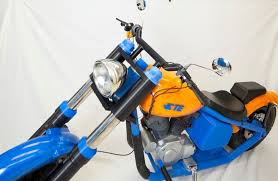
Earlier this year, sensor and antenna specialist TE Connectivity 3D printed a working motorcycle, which it unveiled at the Rapid 2015 show in may.
The design, based on the Harley-Davidson Softail bike, took 1,000 hours to build, weighs 250 lbs., and cost roughly $25,000 to construct. It includes a 750-watt, 1hp electric motor (purchased separately).
The frame was created via fused deposition modeling on Stratasys printers using ABS filament and Ultem 9085 resin, while the metal parts were created from bronze using direct laser sintering. The bearings are made of plastic as well, and have held up under rigorous testing. The motor, belt drive, mirrors, tires, battery pack, and kickstand were not printed.
 The project highlighted a number of limitations and challenges when it comes to printing large objects, including failed component prints and issues with solvent weeping through the completed parts. "It took us 150 to 170 hours of build time for the frame," said principal engineer Charles Fry. "As we got halfway through some prints, they'd fail; that can really add time to the build."
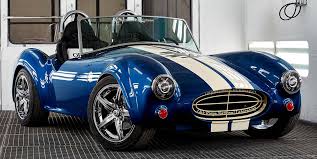
The U.S. Department of Energy one-upped that accomplishment by 3D printing a replica of the Ford/Shelby AC Cobra sports car. The team there printed the plastic body and fitted it onto an electrical propulsion system as a way to test large-scale printing.
“The capability to balance thermal loads was an important one, the ability to achieve very, very high-quality, professional-grade surface finish, the ability to custom design around components that we were going to put in. So, this example has one motor and battery but we could relatively easily change over to a completely different motor and battery, power train, suspension system ... because of 3D printing," said Robert Ivester of the Department's Advanced Manufacturing Office in an article on Voice of America.
During tests at the National Transportation Research Center, the car was able to achieve speeds of 128 kph. The car was displayed at the North American International Auto Show in Detroit in January.
Last year, Local Motors printed and assembled a car at the IMTS show. An initial version of that car and the AC Cobra were both printed at Oak Ridge National Laboratories using the Big Area Additive Manufacturing (BAAM) machine.
Source:


Brian Albright is the editorial director of Digital Engineering.
Contact him at [email protected].






About Us · Contact Us · Editorial Team · Advertising · Privacy Policy · Subscriber Services · © 2026 Digital Engineering 24/7 · Peerless Media