Helping design and engineering professionals discover, evaluate and specify technologies and processes that shorten the design cycle and enable success.


Alert!
Digital Engineering ceased publication on July 1, 2026. This website remains available as an archive of engineering content.
For inquiries or information, please email [email protected].

Digital Engineering April 2026
In the latest issue of Digital Engineering, we take a look at the latest innovations in design for additive manufacturing, including the use of natural language inputs, social media cosplayers, and AI integration. The issue also includes a feature…

January Special Focus Issue: Design for Additive
In this Special Focus Issue of Digital Engineering, learn about the latest advancements in design for additive manufacturing, including new software tools, additive in automotive, custom medical devices, and more.
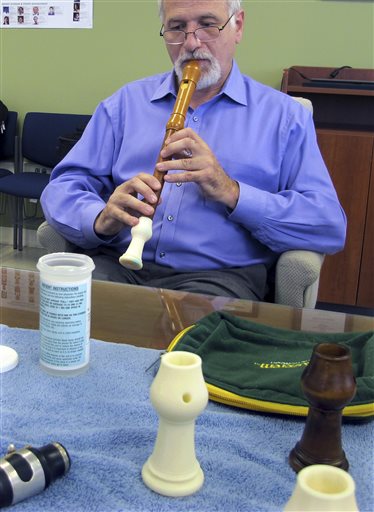 Dr. Robert Howe plays an antique recorder that was repaired using 3D printed parts. Image: AP
Connecticut researchers are applying scanning and 3D printing to help make product parts for rare, fragile, and very old musical instruments that could not only help make it easier to actually play them, but could provide a better understanding of how classical compositions were actually meant to sound at the time they were composed.
The project was proposed by Dr. Robert Howe, a reproductive endocrinologist in Massachusetts who also happens to be a doctoral student in music theory and history at the University of Connecticut. Howe was familiar with using CT scanning, and thought that the same technology could be used to study fragile musical instruments.
Collaborating with faculty in the music and mechanical engineering departments, Howe and the researchers developed a way to use CT scanning to make images of instruments and to print 3D copies of parts.
Studying rare antique instruments has always been limited by the fact that they can't be pulled apart to examine their innards, and by the limitations of X-ray technology. Using the CT scanning process the group developed (which allows the scanning of metal and wood simultaneously) eliminates the risk of damage, and is much more revealing. An 18th-century English horn, for example, was scanned and found to include a more complicated construction than was suspected.
The group was also able to produce an exact replica of one of the original mouthpieces designed by Adolphe Sax for a 19th century saxophone. In the past, doing so would have required using calipers (which could damage the original mouthpiece) or using ill-fitting modern mouthpieces. The 3D printed replica was produced for around $18 in a fraction of the time it would have taken using manual methods.
The technology could eventually be used to create copies of entire instruments.
Source: CBS


Brian Albright is the editorial director of Digital Engineering.
Contact him at [email protected].






About Us · Contact Us · Editorial Team · Advertising · Privacy Policy · Subscriber Services · © 2026 Digital Engineering 24/7 · Peerless Media