Helping design and engineering professionals discover, evaluate and specify technologies and processes that shorten the design cycle and enable success.


Alert!
Digital Engineering ceased publication on July 1, 2026. This website remains available as an archive of engineering content.
For inquiries or information, please email [email protected].
Sponsored

Digital Engineering April 2026
In the latest issue of Digital Engineering, we take a look at the latest innovations in design for additive manufacturing, including the use of natural language inputs, social media cosplayers, and AI integration. The issue also includes a feature…

January Special Focus Issue: Design for Additive
In this Special Focus Issue of Digital Engineering, learn about the latest advancements in design for additive manufacturing, including new software tools, additive in automotive, custom medical devices, and more.
Each year approximately 1,500 children in the US alone are born with upper-limb differences.
Many of these children are unable to use traditional prosthetic devices. For those who can, the high cost may put them out of reach.
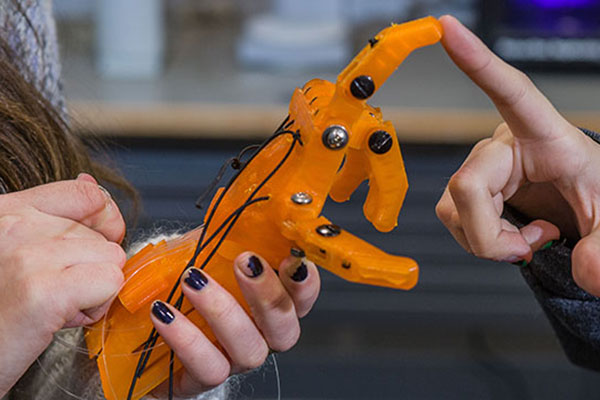
In the fall of 2014, biomedical engineering students at the University of North Carolina at Chapel Hill created a prosthetic device for a child who had few options.
Using 3D printing, they were able to make this hand for less than $40 worth of materials. While going through this process, these students realized the growing need to make hands for other children, and The Helping Hand Project was formed.
Using a mix of open-source and custom designs, The HHP continues to provide prosthetic devices to children in need.
The HHP maintains contact with these children, so they may receive new devices as they age. And through in-person meetings and online groups, The HHP helps these kids and their families with support that goes beyond providing a prosthetic device.
Many children who have physical disabilities and need prosthetic hands can use standard designs, but some require custom designs that fit their unique anatomies.
For all kinds of hands, The HHP engineers design and print devices using SOLIDWORKS applications on the ThinkStation P500. And to keep the waiting list for new prosthetics as short as possible, The HHP counts on Lenovo’s lead ThinkStation engineer to quickly 3D print devices at Lenovo’s own facility.
“Thanks so much to The Helping Hand Project for helping my son feel like a super hero.” – Wendy Barnes, whose child received a HHP device


We are proud to be the world's largest PC vendor. Our portfolio also includes workstations, servers, storage solutions, IT management software, smart TVs, tablets, smartphones, and even apps.As the world becomes faster, more demanding, and…

Making the Case for Engineering Workstation Upgrades
In this Making the Case whitepaper, Lenovo outlines how upgrading to the latest generation of professional workstations can provide a return on investment through increased engineering efficiency and greater flexibility.






About Us · Contact Us · Editorial Team · Advertising · Privacy Policy · Subscriber Services · © 2026 Digital Engineering 24/7 · Peerless Media