Helping design and engineering professionals discover, evaluate and specify technologies and processes that shorten the design cycle and enable success.



Digital Engineering April 2026
In the latest issue of Digital Engineering, we take a look at the latest innovations in design for additive manufacturing, including the use of natural language inputs, social media cosplayers, and AI integration. The issue also includes a feature…

January Special Focus Issue: Design for Additive
In this Special Focus Issue of Digital Engineering, learn about the latest advancements in design for additive manufacturing, including new software tools, additive in automotive, custom medical devices, and more.
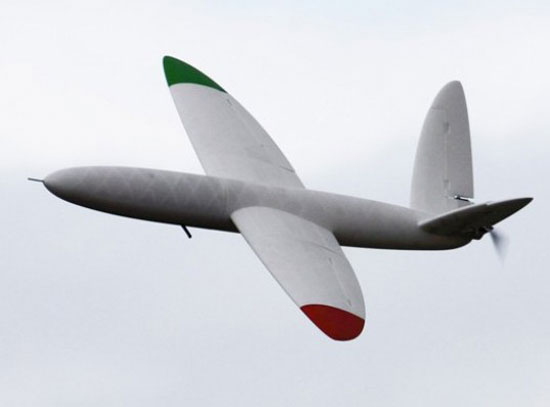
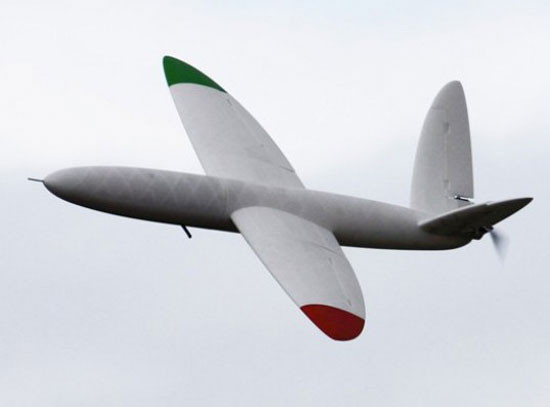
We first looked at AM and aerospace all the way back here and more recently here. In 2011, the University of Southampton demonstrated a 3D printed unmanned aerial vehicle (UAV). Part of what made the UAV of interest to the aerospace community was that it was printed as one piece, rather than as a number of different parts that required additional construction. This offered the possibility of speeding up production.
Other AM-created aircraft have followed, using a number of different printing processes, and the value of AM for aerospace increased when Optomec and Stratasys joined forces to demonstrate how AM could be leveraged to build printed circuit boards directly onto parts of a UAV. Industry took notice.
At the Farnborough Airshow, EADS showcased a new UAV prototype designed by four students at the University of Leeds and built using AM. Although the prototype is plastic, EADS has declared its intentions to manufacture the UAV using direct metal laser sintering. The design was drawn up specifically with AM in mind to optimize structural and aerodynamic characteristics.
According to EADS, the design, “…would otherwise be difficult and expensive to realize for an aircraft of this scale.” The new UAV is also semi-modular, allowing for different wings to be attached to the frame, making the UAV adaptable for different types of missions. Even better, if a specific wing design is required, it can be printed up in a relatively short period of time.
Manned aircraft have also benefited from 3D printing. CFM International has announced it will be using AM to produce parts for the Leap-X family of engines for narrowbody aircraft. CFM hasn’t released much in the way of details about exactly which pieces of the engines will be produced through AM, but has said they’ll be using a process based on research conducted by GE.
"With additive, you can make the shape much more complex," said Prabhjot Singh, manager of the additive manufacturing lab at the Global Research Center. "It's functionally equivalent, but a lot lighter in weight, which corresponds to fuel savings. It's most suitable when you have a complex design with a large number of steps or a material that is hard to process. Geometry has almost no bearing on the manufacturing capability."
Below you’ll find a short video about the University of Southampton’s plane.
Sources: Flightglobal, AIN, DVICE


John Newman is a Digital Engineering contributor who focuses on 3D printing. Contact him via [email protected] and read his posts on Rapid Ready Technology.
Follow DE
Join over 90,000 engineering professionals who get fresh engineering news as soon as it is published.






About Us · Contact Us · Editorial Team · Advertising · Privacy Policy · Subscriber Services · © 2026 Digital Engineering 24/7 · Peerless Media