Helping design and engineering professionals discover, evaluate and specify technologies and processes that shorten the design cycle and enable success.



Digital Engineering April 2026
In the latest issue of Digital Engineering, we take a look at the latest innovations in design for additive manufacturing, including the use of natural language inputs, social media cosplayers, and AI integration. The issue also includes a feature…

January Special Focus Issue: Design for Additive
In this Special Focus Issue of Digital Engineering, learn about the latest advancements in design for additive manufacturing, including new software tools, additive in automotive, custom medical devices, and more.
Sadly, reality hasn’t quite cooperated with that vision of the future. For all its potential, 3D printing has yet to really capture the imagination of the general public, and is still seen as too complex for widespread public consumption. MakerBot, now a subsidiary of Stratasys, already felt the crunch of failed expectations with two rounds of layoffs, and now 3D Systems (3DS) has decided to axe the Cube, its entry-level system for the home 3D printer market.
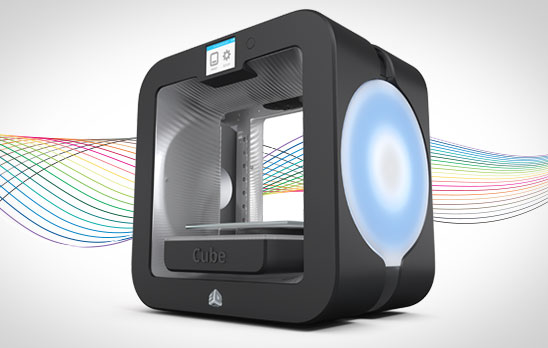 The Cube 3 offers multiple extruder heads to create multi-color prints. Courtesy of 3D Systems.
"In connection with our ongoing review of our business and industry, we believe that the most meaningful opportunities today are in professional and industrial settings, from the product design shop to the operating room to the factory floor," said Andy Johnson, interim CEO and CLO, 3DS. "We are focusing our efforts on enabling professionals and companies to improve their designs, transform their workflows, bring innovative products to market and drive new business models."
The decision comes after a year in which AM stocks in general took a thorough beating, falling from (perhaps overinflated) giddy heights to a lower, but potentially more stable, share price. 3DS moves from swimming in investor cash, much of which was leveraged for acquisitions, to cost-cutting behavior. Along with ending production of the Cube, 3DS will also be taking Cubify, its online support and AM marketplace, offline.
Does this mean the end of home 3D printing? Not remotely. While MakerBot and 3DS might be suffering from a slump, the home market will still have plenty of support from smaller companies. Taken as a whole, those companies might actually be part of the problem for the big names in AM. Small companies are more agile and are able to offer home systems for a fraction of what 3DS or Stratasys have to charge just to break even. The market just isn’t big enough yet for sales volume to trump all other concerns.
Below you’ll find a video about the Cube.
Source: 3DS


John Newman is a Digital Engineering contributor who focuses on 3D printing. Contact him via [email protected] and read his posts on Rapid Ready Technology.
Follow DE
Join over 90,000 engineering professionals who get fresh engineering news as soon as it is published.






About Us · Contact Us · Editorial Team · Advertising · Privacy Policy · Subscriber Services · © 2026 Digital Engineering 24/7 · Peerless Media