Helping design and engineering professionals discover, evaluate and specify technologies and processes that shorten the design cycle and enable success.


Alert!
Digital Engineering ceased publication on July 1, 2026. This website remains available as an archive of engineering content.
For inquiries or information, please email [email protected].

Digital Engineering April 2026
In the latest issue of Digital Engineering, we take a look at the latest innovations in design for additive manufacturing, including the use of natural language inputs, social media cosplayers, and AI integration. The issue also includes a feature…

January Special Focus Issue: Design for Additive
In this Special Focus Issue of Digital Engineering, learn about the latest advancements in design for additive manufacturing, including new software tools, additive in automotive, custom medical devices, and more.
Additive manufacturing is upending traditional manufacturing processes, and unlocking a host of new capabilities. In addition to being able to design and produce lighter and more complex parts and products, companies can also potentially save costs throughout the manufacturing value chain using 3D printing.
In its new white paper, “5 Ways to Stop Wasting Money on Production Processes,” Ultimaker explains how fused filament fabrication (FFF) 3D printing can improve cost efficiency.
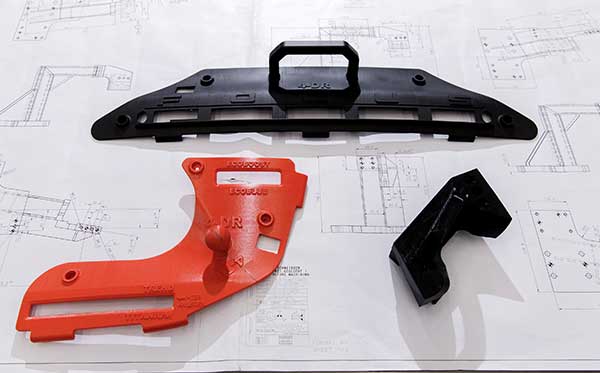
Written by Ultimaker’s in-house 3D printing experts, the new guide explains how 3D printing removes hurdles that can drive up production costs. Those cost savings can come via accelerating design validation through faster production of prototypes and initial modeling; by enabling companies to produce tooling quickly and easily in-house; and by improving manufacturing scalability to meet shifting demand.
To illustrate the potential savings, Ultimaker has included a variety of use cases, including 3D printing applications in use at Ford Motor Company, the Royal Netherlands Air Force, Sylatech, and Florenradica.
Check out Ultimaker’s new white paper on reducing production costs here. Downloading the paper requires registration.


From the very beginning, our mission has been to accelerate the world’s transition to local manufacturing and digital distribution. Our passion is to deliver a 3D printing system that drives business success across the world. That’s why…

Insider Q&A: 3D Printing End Use Parts
In this Insider Q&A, the experts at Ultimaker explain how 3D printing can be used for spare parts, jigs and fixtures in a production environment.

DE's editors contribute news and new product announcements to Digital Engineering. Press releases may be sent to them via [email protected].
Follow DE






About Us · Contact Us · Editorial Team · Advertising · Privacy Policy · Subscriber Services · © 2026 Digital Engineering 24/7 · Peerless Media